Mammal TGF-β1 ELISA Kit
 Protocol Booklet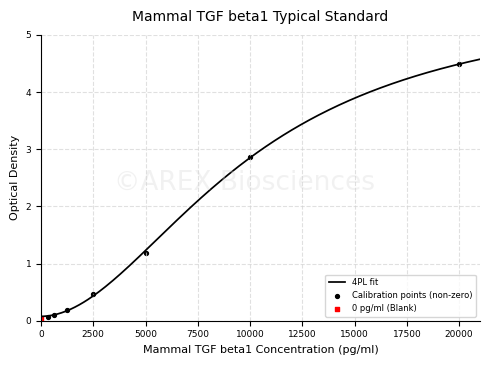
Key features and details
- Specification:
- Reactivity:
- Sensitivity:
- Standard Curve Range:
- Standard Curve Gradient:
- Number of Incubations:
- Sample Volume:
- Assay type:
- Operation Duration:
-
Brand:

CAT.NO. : AEH0012
US$ Please choose
US$ Please choose
Size:
Trail, Bulk size or Custom requests Please contact us
 Product Details
Background
Transforming Growth Factor Beta 1, 2, and 3 (TGF-beta 1, TGF-beta 2, and TGF-beta 3) are highly pleiotropic cytokines that virtually all cell types secrete. TGF-beta molecules are proposed to act as cellular switches that regulate processes such as immune function, proliferation, and epithelial-mesenchymal transition. Targeted deletions of these genes in mice show that each TGF-beta isoform has some non-redundant functions: TGF-beta 1 is involved in hematopoiesis and endothelial differentiation; TGF-beta 2 affects development of cardiac, lung, craniofacial, limb, eye, ear, and urogenital systems; and TGF-beta 3 influences palatogenesis and pulmonary development. The full range of in vitro biological activities of TGF-beta 5 has not yet been explored. However, TGF-beta 1, TGF-beta 2, TGF-beta 3, and TGF-beta 5 have been found to be largely interchangeable in an inhibitory bioassay, and it is anticipated that TGF-beta 5 will show a spectrum of activities similar to the other TGF-beta family members. To date, the production of TGF-beta 5 has only been demonstrated in Xenopus.
- TGF-beta ligands are initially synthesized as precursor proteins that undergo proteolytic cleavage. The mature segments form active ligand dimers via a disulfide-rich core consisting of the characteristic 'cysteine knot'. TGF-beta signaling begins with binding to a complex of the accessory receptor betaglycan (also known as TGF-beta RIII) and a type II serine/threonine kinase receptor termed TGF-beta RII. This receptor then phosphorylates and activates a type I serine/threonine kinase receptor, either ALK-1 or TGF-beta RI (also called ALK-5). The activated type I receptor phosphorylates and activates Smad proteins that regulate transcription. Use of other signaling pathways that are Smad-independent allows for distinct actions observed in response to TGF-beta in different contexts.
Typical data
|
pg/ml |
O.D. |
Average |
Corrected |
|
|
0.00 |
0.0219 |
0.0270 |
0.0245 |
|
|
312.50 |
0.0561 |
0.0568 |
0.0565 |
0.0320 |
|
625.00 |
0.0973 |
0.0945 |
0.0959 |
0.0715 |
|
1250.00 |
0.1937 |
0.1982 |
0.1960 |
0.1715 |
|
2500.00 |
0.4737 |
0.4704 |
0.4721 |
0.4476 |
|
5000.00 |
1.2210 |
1.1640 |
1.1925 |
1.1681 |
|
10000.00 |
2.8550 |
2.8810 |
2.8680 |
2.8436 |
|
20000.00 |
4.4672 |
4.5023 |
4.4848 |
4.4603 |
Precision
Intra-assay Precision (Precision within an assay) Three samples of known concentration were tested twenty times on one plate to assess intra-assay precision.
Inter-assay Precision (Precision between assays)
Inter-assay Precision (Precision between assays)
| Intra-assay Precision | Inter-assay Precision | |||||
| Sample Number | S1 | S2 | S3 | S1 | S2 | S3 |
| 22 | 22 | 22 | 6 | 6 | 6 | |
| Average(pg/ml) | 195.0 | 1090.8 | 3619.9 | 237.3 | 1154.4 | 3711.7 |
| Standard deviation | 10.3 | 67.7 | 202.6 | 16.3 | 67.5 | 144.7 |
| Coefficient of variation(%) | 5.3 | 6.2 | 5.6 | 6.8 | 5.8 | 3.9 |
Recovery
The spike recovery was evaluated by spiking 3 levels of mammal TGF beta1 into health serum sample. The un-spiked serum was used as blank in this experiment.
The recovery ranged from 88% to 105% with an overall mean recovery of 99%.
The recovery ranged from 88% to 105% with an overall mean recovery of 99%.
Sample Values
| Sample Matrix | Sample Evaluated | Range (ng/ml) | Detectable (%) | Mean of Detectable (ng/ml) |
| Serum | 30 | 35.3-74.7 | 100 | 58.4 |
Serum/Plasma – Thirty samples from apparently healthy volunteers were evaluated for the presence of TGF-β1 in this assay. No medical histories were available for the donors.
New Products