LTBP-2 mouse monoclonal Antibody (E-10)

Key features and details

  • Target: LTBP-2
  • Host: Mouse
  • Reactivity: Human, Mouse, Rat
  • Clonality: Monoclonal
  • Application: WB, IP, IF, ELISA
  • Storage: -20°C
  • Brand:
CAT.NO. : ARA0002
US$ Please choose
US$ Please choose
Size:
Trail, Bulk size or Custom requests Please contact us
Product Details
Background
Transforming growth factor (TGF) β is secreted as part of an inactive complex that often includes latent TGFβ-binding protein (LTBP). The LTBP family of proteins has a multidomain structure with cysteine-rich motifs. Specifically, LTBP-2 is an essential part of elastin-containing microfibrils. It contains 20 EGF-like repeats and 4 copies of an 8-cysteine repeat. Human foreskin fibroblasts synthesize LTBP-2 as a protein. During rodent development, LTBP-2 co-localizes with tropoelastin in various tissues such as the lung, dermis, epicardium, pericardium, and heart valves. In the young adult mouse, it also co-localizes with tropoelastin in the spleen. Pseudoexfoliation (PEX) syndrome is a systemic condition marked by the abnormal production and accumulation of a pathologic fibrillar extracellular material in numerous intra- and extraocular tissues. The fact that LTBP-1 and LTBP-2 co-localize with latent TGFβ1 and with fibrillin-1 on PEX fibrils implies a potential mechanism for regulating TGFβ1 activity in the eyes affected by PEX. Finally, the LTBP-2 gene is mapped to human chromosome 14q24.3.
Application
To ensure optimal assay performance, AREX recommends conducting reagent titration tailored to each testing system for optimal detection results.

Application

Dilution Ratio

WB

1:100-1:1000

IF/ICC

1:50-1:500

ELISA

1:30-1:3000

IP

1-2 µg/100-500 µg total protein

*Results are sample-specific. Please refer to your local assay conditions and test parameters for reference.
Overview

Isotype

Mouse IgG2b kappa light chain

Target Antigen

LTBP-2 (Latent-transforming growth factor beta-binding protein 2)

Gene Name

LTBP2

UniProt ID

Q14767 (Human), O88496 (Mouse), O35807 (Rat)

Entrez Gene ID

4053 (Human), 16997 (Mouse), 83768 (Rat)

Molecular Weight

210/175 kDa (under non-reducing conditions), 240 kDa (glycoprotein)

Gene Aliases

C14orf141, GLC3D, LTBP3, MSPKA, MSTP031, WMS3

Immunogen

amino acids 211-480 mapping within an internal region of LTBP-2 of human origin

Form/Buffer

PBS with < 0.1% sodium azide and 0.1% gelatin

*AREX continuously optimizes our products. Webpage content may not reflect the latest updates. For inquiries, please contact info@arexbio.com or your local distributor.
*Clone Number, Reactivity, Source/Host and Clonality can be found in the product name and Key Features section above.
Data

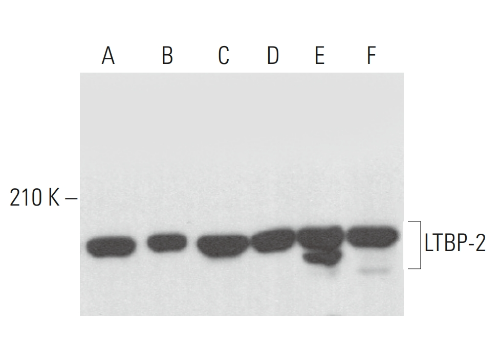
Western blot analysis of LTBP-2 expression in DU 145 (A), PC-3 (B), F9 (C), NIH/3T3 (D) and PC - 12 (E) whole cell lysates and rat testis tissue extract (F).
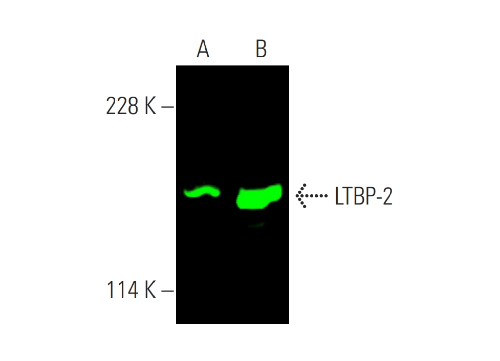
Near-infrared western blot analysis of LTBP-2 expression in PC-3 (A) and PC-12 (B) whole cell lysates. 

Storage
Store at 4°C, DO NOT FREEZE. Stable for one year from the date of shipment.
Note
For Research Use Only. Not for diagnostic, therapeutics, prophylactic or in vivo use.
FAQs
What are the main types of research antibodies and how do they differ?
Research antibodies are mainly divided into monoclonal antibodies and polyclonal antibodies. Monoclonal antibodies typically offer higher specificity and better batch-to-batch consistency, while polyclonal antibodies often provide stronger affinity but may show more variation between batches. The choice depends on your specific experimental needs.
How can I tell if a research antibody is suitable for my experiment?
It is recommended to carefully review the product datasheet for validated applications, species reactivity, recommended dilutions, and published references. For new antibodies, performing a small-scale validation with positive control samples is usually helpful.
Can improper storage of research antibodies affect experimental results?
Yes. Antibodies are sensitive to temperature, repeated freeze-thaw cycles, and contamination. Improper storage may lead to reduced activity, increased background, or weaker signals. It is best to follow the storage instructions provided in the product datasheet.
Why doesn’t the recommended dilution in the datasheet work well in my experiment?
The recommended dilution is based on the supplier’s test conditions. Factors such as sample type, fixation method, and detection system in your lab can influence the optimal working concentration. Performing a dilution series optimization in your own system is often necessary.
What precautions should I take when using a newly purchased research antibody for the first time?
It is advisable to briefly centrifuge the antibody (especially concentrated or lyophilized ones), then perform a small-scale pilot experiment using the recommended conditions. Recording the batch number and usage date is also helpful for future tracking.
New Products
Get in touch with AREX
Name:*
Tel/Phone:*
Company:*
Email:*
Inquiry:
Captcha*
Submitting your email information means that you are willing to receive email information from AREX regarding technology, applications, products, and events. By clicking on the 'unsubscribe' button in the email or by contacting info@arexbio.com You can unsubscribe at any time by sending an email. Regarding your data usage information, please refer to our privacy policy.
© AREX 2024. All Rights Reserved. Sitemap
0.347221s