KLF1/5/7 Rabbit Polyclonal Antibody
 Datasheet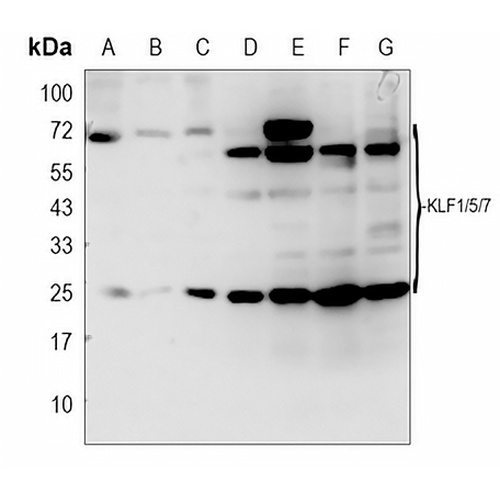
Key features and details
- Target:
- Source/Host:
- Reactivity:
- Clonality:
- Applications:
- Conjugation:
- Storage:
-
Brand:

 Product Details
WB | 1:500 - 1:1000 |
IF/ICC | 1:50 - 1:200 |
Description | Rabbit polyclonal antibody to KLF1/5/7 |
Specificity | Recognizes endogenous levels of KLF1/5/7 protein. |
Antibody Type | Primary antibody |
Imnunogen | KLH-conjugated synthetic peptide encompassing a sequence within the C-term region of human KLF1/5/7. The exact sequence is proprietary. |
Purification | The antibody was purified by immunogen affinity chromatography. |
Molecular Weight | Predicted: 38; Observed: 25-70 kD |
Form/Buffer | Liquid in 0.42% Potassium phosphate, 0.87% Sodium chloride, pH 7.3, 30% glycerol, and 0.01% sodium azide. |
Alternative Names | KLF1; EKLF; Krueppel-like factor 1; Erythroid krueppel-like transcription factor; EKLF; KLF5; BTEB2; CKLF; IKLF; Krueppel-like factor 5; Basic transcription element-binding protein 2; BTE-binding protein 2; Colon krueppel-like factor; GC-box-binding protein 2; Intestinal-enriched krueppel-like factor; Transcription factor BTEB2; KLF7; UKLF; Krueppel-like factor 7; Ubiquitous krueppel-like factor |
Gene Symbol | KLF1; KLF5; KLF7 |
Entrez Gene | 10661; 688; 8609(Human) |
SwissProt | Q13351; Q13887; O75840(Human) |
*Clone Number, Reactivity, Source/Host and Clonality can be found in the product name and Key Features section above.
Western blot analysis of KLF1/5/7 expression in HEK293T (A), H1688 (B), A549 (C), mouse liver (D), rat liver (E), mouse spleen (F), rat spleen (G) whole cell lysates. (Predicted band size: 38; 50; 33 kD; Observed band size: 25-70 kD)
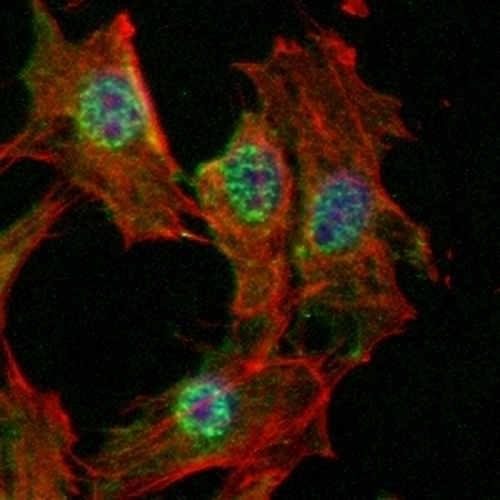
Immunofluorescent analysis of KLF1/5/7 staining in NIH3T3 cells. Formalin-fixed cells were permeabilized with 0.1% Triton X-100 in TBS for 5-10 minutes and blocked with 3% BSA-PBS for 30 minutes at room temperature. Cells were probed with the primary antibody in 3% BSA-PBS and incubated overnight at 4 °C in a hidified chamber. Cells were washed with PBST and incubated with a AREX® Fluor 488 -conjugated secondary antibody (green) in PBS at room temperature in the dark. Phalloidin - AREX® Fluor 594 was used to stain Actin filaments (red). DAPI was used to stain the cell nuclei (blue).
FAQs
 New Products