CD22 Rabbit Monoclonal Antibody(ARM943)
 Datasheet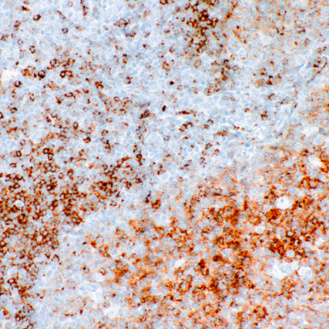
Key features and details
- Target:
- Clone ID:
- Source/Host:
- Reactivity:
- Applications:
- Dilution:
- Clonality:
- Storage:
-
Brand:

CAT.NO. : ARM6733
US$ Please choose
US$ Please choose
Size:
Trail, Bulk size or Custom requests Please contact us
 Product Details
Background
CD22 antigen appears early in B-cell lymphocyte differentiation at approximately the same stage as the CD19 antigen. Mediates B-cell B-cell interactions. May be involved in the localization of B-cells in lymphoid tissues. Binds sialylated glycoproteins; one of which is CD45. Preferentially binds to alpha-2,6-linked sialic acid. The sialic acid recognition site can be masked by cis interactions with sialic acids on the same cell surface. Upon ligand induced tyrosine phosphorylation in the immune response seems to be involved in regulation of B-cell antigen receptor signaling. Plays a role in positive regulation through interaction with Src family tyrosine kinases and may also act as an inhibitory receptor by recruiting cytoplasmic phosphatases via their SH2 domains that block signal transduction through dephosphorylation of signaling molecules. CD22 may be a useful marker for phenotyping mature leukemias, as CD22 membrane expression has been shown to be limited to the late differentiation stages between mature B cells (CD22+) and plasma cells (CD22-). CD22 is also strongly expressed in hairy cell leukemia.
Application
To ensure optimal assay performance, AREX recommends conducting reagent titration tailored to each testing system for optimal detection results.
*Results are sample-specific. Please refer to your local assay conditions and test parameters for reference.
Application | IHC |
Dilution Ratio | 1:50 - 1:200 |
Overview
Antibody Type | Primary antibodies |
Isotype | IgG |
Positive Control | Tonsil |
Localization | Membranous / Cytoplasmic |
Form/Buffer | Tris Buffer, pH 7.3 - 7.7, with 1% BSA and <0.1% Sodium Azide |
Purification | Purified |
Conjugation | Unconjugated |
Alternative Names | SIGLEC2; B-cell receptor CD22; B-lymphocyte cell adhesion molecule; BL-CAM; Sialic acid-binding Ig-like lectin 2; Siglec-2; T-cell surface antigen Leu-14; CD22 |
Gene Symbol | CD22 |
Entrez Gene | 933 |
Uniprot | P20273 |
*Clone Number, Reactivity, Source/Host and Clonality can be found in the product name and Key Features section above.
Data
Immunohistochemical staining of human tonsil tissue using CD22 Rabbit Monoclonal Antibody (ARM943).
Research Use Only
For Research Use Only. Not for diagnostic, therapeutics, prophylactic or in vivo use.
Storage
Store at 4°C short term. For long term storage, store at -20°C, avoiding freeze/thaw cycles.
FAQs
Are the pathology antibodies provided by AREX raw antibodies or ready-to-use solutions?

AREX Biosciences specializes in supplying high-quality IHC pathology raw antibodies (Raw Antibodies). We do not manufacture ready-to-use working solutions or IVD diagnostic reagents. We mainly provide concentrated raw materials to pathology reagent manufacturers and diagnostic platform companies to support product development and OEM production.
What development scenarios are pathology raw antibodies mainly used for?
Our raw antibodies are primarily used for the research, performance optimization, validation, and commercial-scale production of pathology IHC detection reagents. They are also suitable for companion diagnostics (CDx) projects and antibody screening.
How can I evaluate whether a raw antibody is suitable for our staining platform?
It is recommended to focus on specificity, sensitivity, background control, and performance on your target automated platforms (such as Roche Ventana, Leica Bond, Agilent Dako, etc.). We can provide internal test data for reference, but we recommend partners perform actual validation on their own platforms.
Can you provide samples for platform validation?
Yes. We can provide validation samples depending on the specific product. Some products may be provided free of charge, while others may involve a small sample fee. Handling fee and shipping fee will be charged separately. Please contact us for detailed confirmation.
How should raw antibodies be paired with detection systems?
AREX raw antibodies can be used with various polymer detection systems and ancillary reagents. We recommend optimization in combination with the ARExVisual® system or your existing detection platform to achieve better signal intensity and background control.
New Products