Human CD28 ELISA Kit
Key features and details
- Specification:
- Sensitivity:
- Standard Curve Range:
- Standard Curve Gradient:
- Number of Incubations:
- Sample Volume:
- Assay type:
- Operation Duration:
-
Brand:

CAT.NO. : AEH0183
US$ Please choose
US$ Please choose
Size:
Trail, Bulk size or Custom requests Please contact us
 Product Details
Background
CD28 and CTLA-4, together with their ligands, B7-1 and B7-2, constitute one of the dominant costimulatory pathways that regulate T and B cell responses. CD28 and CTLA-4 are structurally homologous molecules that are members of the immunoglobulin (Ig) gene superfamily. Both CD28 and CTLA-4 are composed of a single Ig
V‑like extracellular domain, a transmembrane domain and an intracellular domain. CD28 and CTLA-4 are both expressed on the cell surface as disulfide-linked homodimers or as monomers. The genes encoding these two molecules are closely linked on human chromosome 2 and mouse chromosome 1. Mouse CD28 is expressed constitutively on virtually 100% of mouse T cells and on developing thymocytes. Cell surface expression of mouse CD28 is down-regulated upon ligation of CD28 in the presence of PMA or PHA. In contrast, CTLA-4 is not expressed constitutively but is up-regulated rapidly following T cell activation and CD28 ligation. Cell surface expression of mouse CTLA-4 peaks approximately 48 hours after activation. Although both CTLA-4 and CD28 can bind to the same ligands, CTLA-4 binds to B7-1 and B7-2 with a 20-100 fold higher affinity than CD28. CD28/B7 interaction has been shown to prevent apoptosis of activated T cells via the upregulation of Bcl-xL. CD28 ligation has also been shown to regulate Th1/Th2 differentiation.
V‑like extracellular domain, a transmembrane domain and an intracellular domain. CD28 and CTLA-4 are both expressed on the cell surface as disulfide-linked homodimers or as monomers. The genes encoding these two molecules are closely linked on human chromosome 2 and mouse chromosome 1. Mouse CD28 is expressed constitutively on virtually 100% of mouse T cells and on developing thymocytes. Cell surface expression of mouse CD28 is down-regulated upon ligation of CD28 in the presence of PMA or PHA. In contrast, CTLA-4 is not expressed constitutively but is up-regulated rapidly following T cell activation and CD28 ligation. Cell surface expression of mouse CTLA-4 peaks approximately 48 hours after activation. Although both CTLA-4 and CD28 can bind to the same ligands, CTLA-4 binds to B7-1 and B7-2 with a 20-100 fold higher affinity than CD28. CD28/B7 interaction has been shown to prevent apoptosis of activated T cells via the upregulation of Bcl-xL. CD28 ligation has also been shown to regulate Th1/Th2 differentiation.
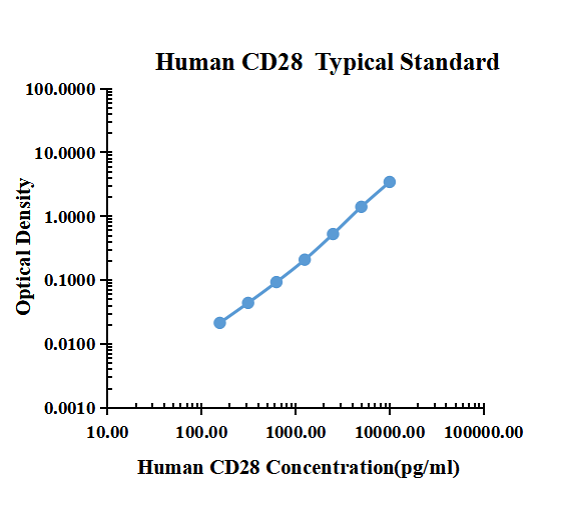
Typical data
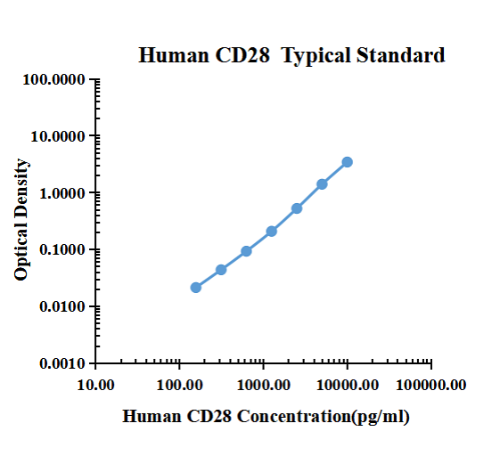
|
pg/ml |
O.D. |
Average |
Corrected |
|
|
0.00 |
0.0102 |
0.0092 |
0.0097 |
|
|
156.25 |
0.0309 |
0.0313 |
0.0311 |
0.0214 |
|
312.50 |
0.0496 |
0.0578 |
0.0537 |
0.0440 |
|
625.00 |
0.0966 |
0.1092 |
0.1029 |
0.0932 |
|
1250.00 |
0.2040 |
0.2336 |
0.2188 |
0.2091 |
|
2500.00 |
0.5139 |
0.5597 |
0.5368 |
0.5271 |
|
5000.00 |
1.3250 |
1.5090 |
1.4170 |
1.4073 |
|
10000.00 |
3.3340 |
3.5900 |
3.4620 |
3.4523 |
Precision
|
Intra-assay Precision |
Inter-assay Precision |
|||||
|
Sample Number |
S1 |
S2 |
S3 |
S1 |
S2 |
S3 |
|
22 |
22 |
22 |
6 |
6 |
6 |
|
|
Average(pg/ml) |
203.4 |
1052.0 |
3276.1 |
166.4 |
957.1 |
3088.7 |
|
Standard Deviation |
11.5 |
37.4 |
176.2 |
3.5 |
29.7 |
91.4 |
|
Coefficient of Variation(%) |
5.6 |
3.6 |
5.4 |
2.1 |
3.1 |
3.0 |
Spike Re
The spike recovery was evaluated by spiking 3 levels of human CD28 into health human serum sample. The un-spiked serum was used as blank in this experiment.
The recovery ranged from 85% to 113% with an overall mean recovery of 103%.
The recovery ranged from 85% to 113% with an overall mean recovery of 103%.
Sample Values
| Sample Matrix | Sample Evaluated | Range (pg/ml) | Detectable (%) | Mean of Detectable (pg/ml) |
|---|---|---|---|---|
| Serum | 30 | 3.32-816.93 | 100 | 104.41 |
Serum/Plasma – Thirty samples from apparently healthy volunteers were evaluated for the presence of CD28 in this assay. No medical histories were available for the donors.
New Products