Cytokeratin 4 Rabbit Monoclonal Antibody(ARA856)
 Datasheet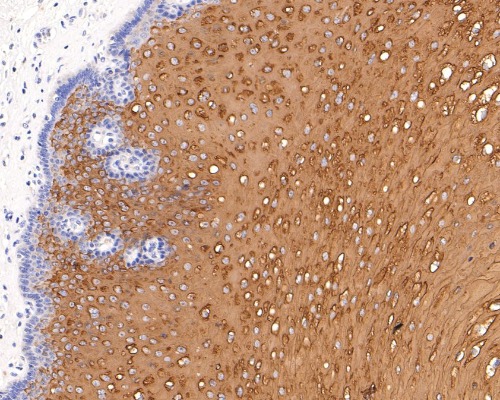
Key features and details
- Target:
- Host:
- Reactivity:
- Clonality:
- Application:
- Storage:
-
Brand:

CAT.NO. : ARA6682
US$ Please choose
US$ Please choose
Size:
Trail, Bulk size or Custom requests Please contact us
 Product Details
Background
Cytokeratins are a subfamily of intermediate filament keratins that are characterized by a remarkable biochemical diversity, which is represented in human epithelial tissues by at least 20 different polypeptides. Cytokeratins range in isoelectric range between 4.9 and 7.8. Cytokeratin 1 has the highest molecular weight, while Cytokeratin 19 has the lowest molecular weight. The cytokeratins are divided into the type I and type II subgroups. Type II family members comprise the basic to neutral members, Cytokeratins 1-8, while the type I group comprises the acidic members, Cytokeratins 9-20. Various epithelia in the human body usually express cytokeratins which are characteristic of the type of epithelium and related to the degree of maturation or differentiation within said epithelium. Cytokeratin subtype expression patterns are used to an increasing extent in the distinction of different types of epithelial malignancies. Cytokeratin 4 is expressed in differentiated layers of the mucosal and esophageal epithelia along with Cytokeratin 13.
Application
To ensure optimal assay performance, AREX recommends conducting reagent titration tailored to each testing system for optimal detection results.
*Results are sample-specific. Please refer to your local assay conditions and test parameters for reference.
Application | Dilution Ratio |
IHC | 1:100-1:500 |
Overview
Antibody Type | Recombinant Rabbit monoclonal Antibody |
Immunogen | Recombinant protein within Human Cytokeratin 4 aa 395 - 520 / 520 |
Molecular Weight | Predicted band size: 56 kDa |
Positive Control | A431, human tonsil tissue, human esophagus tissue |
Conjugation | unconjugated |
Form/Buffer | 1*TBS (pH7.4), 0.05% BSA, 40% Glycerol. Preservative: 0.05% Sodium Azide |
Isotype | IgG |
Purification | Protein A affinity purified |
*Clone Number, Reactivity, Source/Host and Clonality can be found in the product name and Key Features section above.
Data
Immunohistochemical analysis of paraffin-embedded human esophagus tissue using Cytokeratin 4 Rabbit Monoclonal Antibody(ARA856).
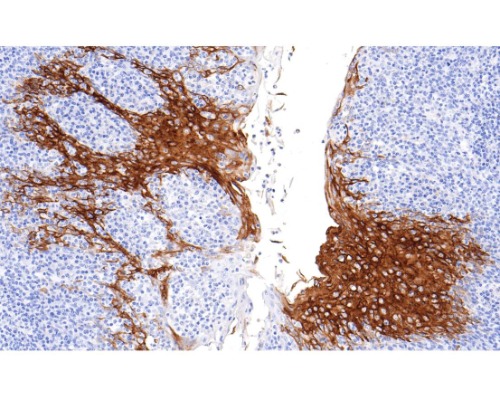
Immunohistochemical analysis of paraffin-embedded human tonsil tissue using Cytokeratin 4 Rabbit Monoclonal Antibody(ARA856).
Storage
Shipped at 4℃. Store at -20℃ for one year. Avoid repeated freeze/thaw cycles.
Note
For Research Use Only. Not for diagnostic, therapeutics, prophylactic or in vivo use.
FAQs
Are the pathology antibodies provided by AREX raw antibodies or ready-to-use solutions?

AREX Biosciences specializes in supplying high-quality IHC pathology raw antibodies (Raw Antibodies). We do not manufacture ready-to-use working solutions or IVD diagnostic reagents. We mainly provide concentrated raw materials to pathology reagent manufacturers and diagnostic platform companies to support product development and OEM production.
What development scenarios are pathology raw antibodies mainly used for?
Our raw antibodies are primarily used for the research, performance optimization, validation, and commercial-scale production of pathology IHC detection reagents. They are also suitable for companion diagnostics (CDx) projects and antibody screening.
How can I evaluate whether a raw antibody is suitable for our staining platform?
It is recommended to focus on specificity, sensitivity, background control, and performance on your target automated platforms (such as Roche Ventana, Leica Bond, Agilent Dako, etc.). We can provide internal test data for reference, but we recommend partners perform actual validation on their own platforms.
Can you provide samples for platform validation?
Yes. We can provide validation samples depending on the specific product. Some products may be provided free of charge, while others may involve a small sample fee. Handling fee and shipping fee will be charged separately. Please contact us for detailed confirmation.
How should raw antibodies be paired with detection systems?
AREX raw antibodies can be used with various polymer detection systems and ancillary reagents. We recommend optimization in combination with the ARExVisual® system or your existing detection platform to achieve better signal intensity and background control.
New Products