Carbonic Anhydrase 14 Rabbit Monoclonal Antibody(ARB580)
 Datasheet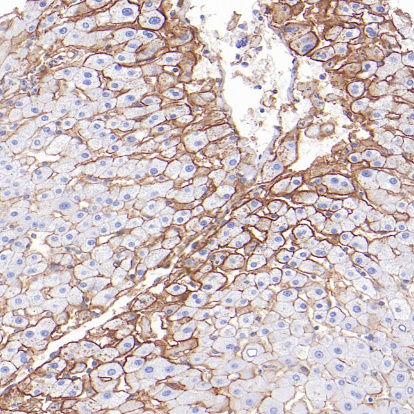
Key features and details
- Target:
- Clone ID:
- Source/Host:
- Reactivity:
- Applications:
- Dilution:
- Clonality:
- Storage:
-
Brand:

CAT.NO. : ARB6872
US$ Please choose
US$ Please choose
Size:
Trail, Bulk size or Custom requests Please contact us
 Product Details
Background
Carbonic Anhydrase 14 (CA14) is a membrane-associated zinc metalloenzyme belonging to the carbonic anhydrase family. It catalyzes the reversible hydration of carbon dioxide to bicarbonate and protons. In the central nervous system, it contributes critically to neuronal signaling, cerebrospinal fluid production, and possibly neuroprotection. Carbonic Anhydrase 14 (CA14) is predominantly expressed in brain and liver. In tumor tissue, it is mainly expressed in malignant melanoma and hepatocellular carcinoma. Carbonic Anhydrase 14 (CA14) demonstrates emerging diagnostic and prognostic relevance in specific malignancies, notably hepatocellular carcinoma (HCC) and malignant melanoma. In HCC, CA14 is frequently overexpressed in tumor tissues compared to adjacent non-tumorous liver, correlating with advanced tumor stage, vascular invasion and poorer overall survival, suggesting utility as a prognostic biomarker. In malignant melanoma, CA14 expression is linked to tumor progression, potentially contributing to extracellular acidosis, invasion and immune evasion within the tumor microenvironment.
Application
To ensure optimal assay performance, AREX recommends conducting reagent titration tailored to each testing system for optimal detection results.
*Results are sample-specific. Please refer to your local assay conditions and test parameters for reference.
Application | Dilution Ratio |
IHC | 1:100 - 1:200 |
Overview
Predicted Molecular Wt | 38kDa |
Purity | ProA affinity purified IgG |
Subcellular location | Membrane |
Swissprot ID | Q9UXU7 |
Immunogen | Synthetic peptide. |
Storage Buffer | PBS 59%, Sodium azide 0.01%, Glycerol 40%, BSA 0.05% |
Recommended Method | Heat induced epitope retrieval with Tris-EDTA buffer (pH 9.0), primary antibody incubate at RT (18℃-25℃) for 30 minutes. |
Alternative Names | Carbonic anhydrase 14 (Carbonate dehydratase XIV) (Carbonic anhydrase XIV) (CA-XIV) |
Gene Symbol | CA14 |
Entrez Gene | 23632 |
*Clone Number, Reactivity, Source/Host and Clonality can be found in the product name and Key Features section above.
Data
Immunohistochemical staining of human liver tissue using Carbonic Anhydrase 14 Rabbit Monoclonal Antibody(ARB580).
Storage
Store at 4°C short term. For long term storage, store at -20°C, avoiding freeze/thaw cycles.
Note
For Research Use Only. Not for diagnostic, therapeutics, prophylactic or in vivo use.
FAQs
Are the pathology antibodies provided by AREX raw antibodies or ready-to-use solutions?

AREX Biosciences specializes in supplying high-quality IHC pathology raw antibodies (Raw Antibodies). We do not manufacture ready-to-use working solutions or IVD diagnostic reagents. We mainly provide concentrated raw materials to pathology reagent manufacturers and diagnostic platform companies to support product development and OEM production.
What development scenarios are pathology raw antibodies mainly used for?
Our raw antibodies are primarily used for the research, performance optimization, validation, and commercial-scale production of pathology IHC detection reagents. They are also suitable for companion diagnostics (CDx) projects and antibody screening.
How can I evaluate whether a raw antibody is suitable for our staining platform?
It is recommended to focus on specificity, sensitivity, background control, and performance on your target automated platforms (such as Roche Ventana, Leica Bond, Agilent Dako, etc.). We can provide internal test data for reference, but we recommend partners perform actual validation on their own platforms.
Can you provide samples for platform validation?
Yes. We can provide validation samples depending on the specific product. Some products may be provided free of charge, while others may involve a small sample fee. Handling fee and shipping fee will be charged separately. Please contact us for detailed confirmation.
How should raw antibodies be paired with detection systems?
AREX raw antibodies can be used with various polymer detection systems and ancillary reagents. We recommend optimization in combination with the ARExVisual® system or your existing detection platform to achieve better signal intensity and background control.
New Products