V5 tag Rabbit Monoclonal Antibody(ARA807)
 Datasheet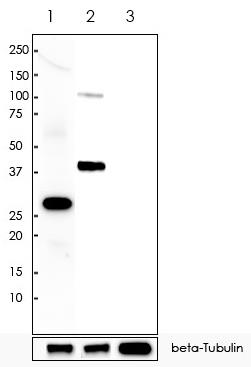
Key features and details
- Target:
- Source/Host:
- Reactivity:
- Clonality:
- Applications:
- Conjugation:
- Storage:
-
Brand:

 Product Details
WB | 1:1000-1:2000 |
IF/ICC | 1:2000-1:10000 |
FC | 1:2000-1:10000 |
IP | 1:50 |
Description | Rabbit Monoclonal Antibody to V5 tag |
Antibody Type | Primary antibody |
Predicted MW | Depending on customers' target of interest |
Immunogen | GKPIPNPLLGLDST (V5 epitope) conjugated to KLH. |
Purification | ProA affinity purified IgG |
Form/Buffer | PBS 59%, Sodium azide 0.01%, Glycerol 40%, BSA 0.82%. |
Alternative Names | simian virus 5 antibody; SPV5gp2; sv5; v-5; V5; V5 Epitope Tag |
*Clone Number, Reactivity, Source/Host and Clonality can be found in the product name and Key Features section above.
Predicted MW: Depend on fusion protein with V5 tag
Lane 1: 293 cell lysates transfected with N-terminal V5 tagged gene (ARA807 at 1:2,000 dilution).
Lane 2: 293 cell lysates transfected with C-terminal V5 tagged gene (ARA807 at 1:2,000 dilution).
Lane 3: Mock 293 cell lysates (ARA807 at 1:2,000 dilution)
All lanes : 2 µg per lane
2nd Ab:
GAR HRP(H+L) 1:5,000
Exposure: 60s
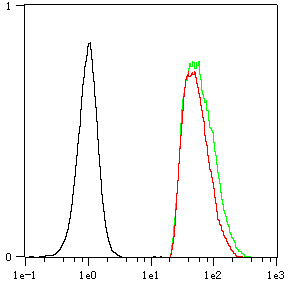
Overlay histogram showing 293 cells transfected with N-terminal (Red) and C-terminal (Green) V5 tagged gene stained with ARA807. The cells were then incubated in the antibody (ARA807 , 1:10,000 dilution) in 1x PBS/1% BSA for 30 min at room temperature. The secondary antibody used was a Goat Anti-Rabbit Alexa Fluor<sup>®</sup> 488 (IgG H+L) at 1:2,000 dilution for 20 min at room temperature. Unlabelled sample (Black) was used as a control.
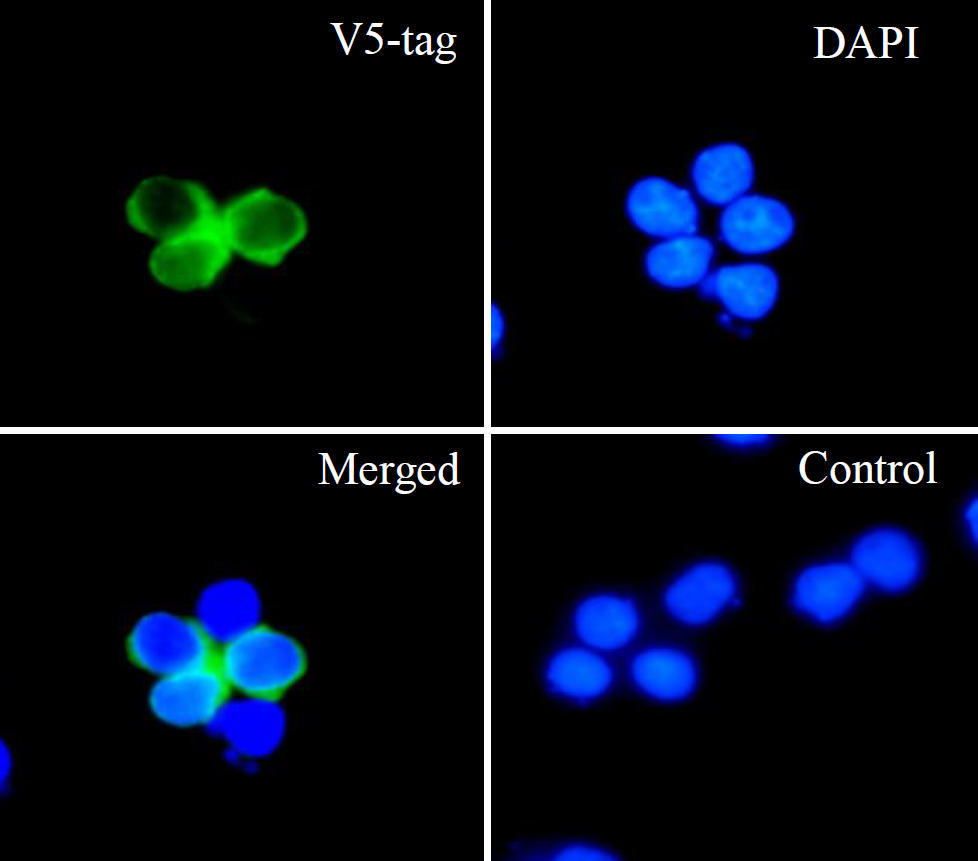
ARA807 staining V5 tag in 293 cells transfected with N-terminal V5 tagged gene by IF/ICC (immunofluorescence/immunocytochemistry). Cells were fixed with paraformaldehyde, permeabilized with 0.1% Triton X-100 and blocked with 10% goat serum for half an hour at room temperature. Samples were incubated with primary antibody (1:10,000) at 4°C. An Alexa Fluor<sup>®</sup> 488-conjugated Goat Anti-Rabbit IgG polyclonal was used as the secondary antibody (1:500). DAPI (blue) was used as the nuclear counter stain.
Control: PBS and secondary antibody, An Alexa Fluor<sup>®</sup> 488-conjugated Goat Anti-Rabbit IgG (1:500).
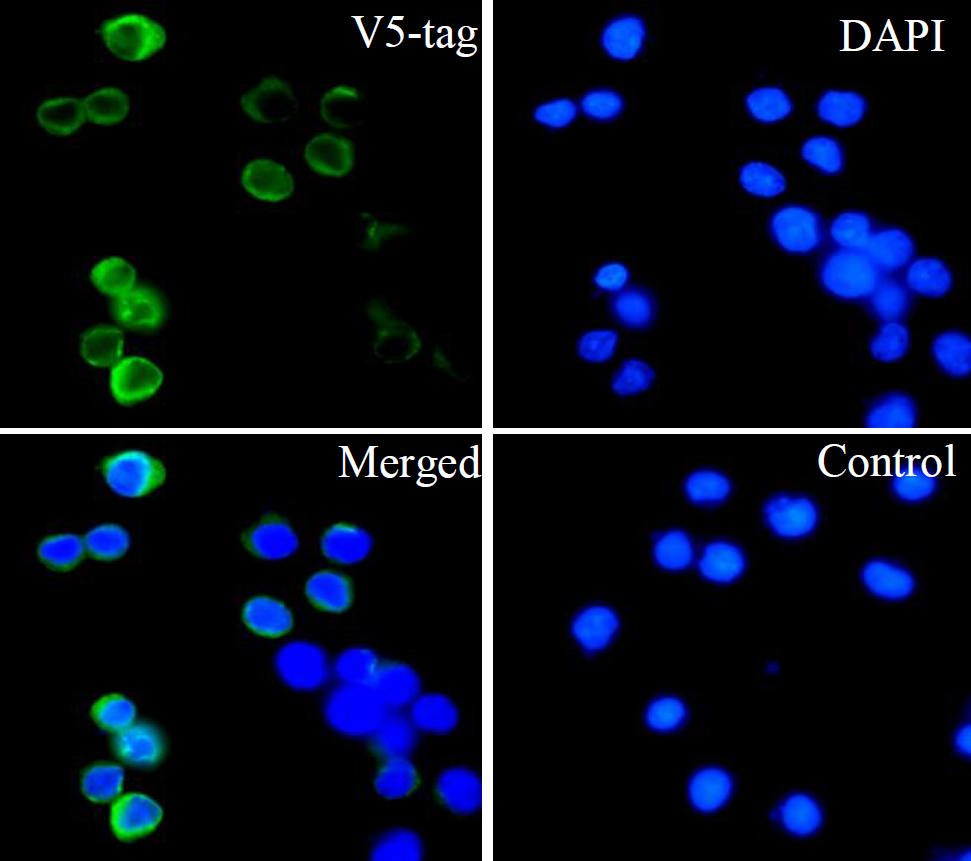
ARA807 staining V5 tag in 293 cells transfected with C-terminal V5 tagged gene by IF/ICC (immunofluorescence/immunocytochemistry). Cells were fixed with paraformaldehyde, permeabilized with 0.1% Triton X-100 and blocked with 10% goat serum for half an hour at room temperature. Samples were incubated with primary antibody (1:10,000) at 4°C. An Alexa Fluor<sup>®</sup> 488-conjugated Goat Anti-Rabbit IgG polyclonal was used as the secondary antibody (1:500). DAPI (blue) was used as the nuclear counter stain.
Control: PBS and secondary antibody, An Alexa Fluor<sup>®</sup> 488-conjugated Goat Anti-Rabbit IgG (1:500).
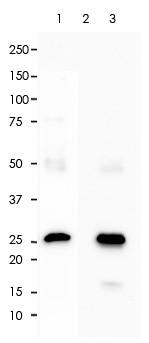
V5 tag was immunoprecipitated from 0.1mg of 293 whole cell lysates transfected with N-terminal V5 tagged gene with ARA807 at 1:50 dilution.
2nd Ab:
GAR HRP for IP 1:500
Lane 1: ARA807 IP in 293 whole cell lysates transfected with N-terminal V5 tagged gene
Lane 2: PBS instead of ARA807 in 293 whole cell lysates transfected with N-terminal V5 tagged gene
Lane 3: 293 whole cell lysate transfected with N-terminal V5 tagged gene, 4 µg (input)
Exposure: 60s
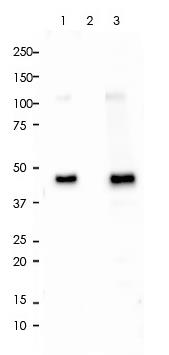
V5 tag was immunoprecipitated from 0.1mg of 293 whole cell lysates transfected with C-terminal V5 tagged gene with ARA807 at 1:50 dilution.
2nd Ab:
GAR HRP for IP 1:500
Lane 1: ARA807 IP in 293 whole cell lysates transfected with C-terminal V5 tagged gene
Lane 2: PBS instead of ARA807 in 293 whole cell lysates transfected with C-terminal V5 tagged gene
Lane 3: 293 whole cell lysate transfected with C-terminal V5 tagged gene, 4 µg (input)
Exposure: 60s
FAQs
 New Products