RIPK3 (Phospho-S227) Rabbit Polyclonal Antibody
Key features and details
- Target:
- Host:
- Reactivity:
- Clonality:
- Applications:
- Conjugation:
- Gene Symbol:
- Storage:
-
Brand:

CAT.NO. : APA11776
US$ Please choose
US$ Please choose
 Product Details
Background
Essential for necroptosis, a programmed cell death process in response to death-inducing TNF-alpha family members. Upon induction of necrosis, RIPK3 interacts with, and phosphorylates RIPK1 and MLKL to form a necrosis-inducing complex. RIPK3 binds to and enhances the activity of three metabolic enzymes: GLUL, GLUD1, and PYGL. These metabolic enzymes may eventually stimulate the tricarboxylic acid cycle and oxidative phosphorylation, which could result in enhanced ROS production.
Application
|
Application |
Dilution Ratio |
|
WB |
1:500 - 1:1000 |
Overview
|
Product Description |
Rabbit polyclonal antibody to RIPK3 (Phospho-S227) |
|
Immunogen |
KLH-conjugated synthetic phosphopeptide corresponding to residues surrounding S227 of human RIPK3 protein. The exact sequence is proprietary. |
|
Purification Method |
The antibody was purified by immunogen affinity chromatography. |
|
Clonality |
Polyclonal |
|
Form |
Liquid in 0.42% Potassium phosphate, 0.87% Sodium chloride, pH 7.3, 30% glycerol, and 0.01% sodium azide. |
|
Gene Symbol |
RIPK3 |
|
Alternative Names |
RIP3; Receptor-interacting serine/threonine-protein kinase 3; RIP-like protein kinase 3; Receptor-interacting protein 3; RIP-3 |
|
Gene ID (Human) |
11035 |
|
Protein ID (Human) |
Q9Y572 |
Data
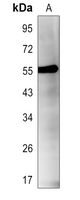
Western blot analysis of RIPK3 (Phospho-S227) expression in HEK293T (A) whole cell lysates. (Predicted band size: 56 kD; Observed band size: 56 kD)
Storage
Store at 4°C short term. For long term storage, store at -20°C, avoiding freeze/thaw cycles.
Note
For Research Use Only. Not for use in diagnostic procedures.
New Products