Human IL-8 ARExSet® antibody pair for ELISA
Key features and details
- Species:
- Size:
- Sample Volume:
- Standard Curve Range:
- Assay type:
- Sensitivity:
- Operation Duration:
- Assay type:
-
Brand:

 Product Details
Interleukin-8 (IL-8), also known as IL-8, GCP-1, and NAP-1, is a heparin-binding 8-9 kDa member of the alpha, or CXC family of chemokines. There are at least 15 human CXC family members that all adopt a three beta -sheet/one alpha -helix structure. Most CXC chemokines show an N-terminal Glu-Leu-Arg (ELR) tripeptide motif. IL-8 circulates as a monomer, homodimer, and heterodimer with CXCL4/PF4. The monomer is considered the most bio-active, while the heterodimer can potentiate PF4 activity. IL-8 oligomerization is modulated by its interactions with matrix and cell surface glycosaminoglycans (GAGs). Mature human IL-8 shares 65-69% amino acid (aa) identity with canine, feline, and porcine IL-8. There is no IL-8 gene counterpart in rodent.
Multiple isoforms of IL-8 are generated through both alternative splicing and differential proteolytic cleavage. In humans, alternative splicing generates an iso-form with an eleven aa substitution at the C-terminus. Proteolytic processing results in N-terminal truncation of IL-8 and is likely a cell-specific event. For example, fibroblasts and endothelial cells generate the 1-77 form by cleaving IL-8 following Glu21, while monocytes and lymphocytes generate the 6-77 form by cleaving following Leu25. These truncated forms generally show increased bioactivity, particularly through the CXCR1 receptor. IL-8 can also undergo citrullination on Arg27 of the precursor, a modification that increases its half-life and ability to induce leukocytosis. A wide variety of cells secrete IL-8 including monocytes and neutrophils, fibroblasts and keratinocytes, mast cells, visceral smooth muscle cells, dendritic cells, type II great alveolar cells, and endothelial cells.
IL-8 bioactivity is mediated through two G-protein-coupled receptors, termed CXCR1/IL-8 RA and CXCR2/IL-8 RB. CXCR1 is 45-50 kDa in size and is used almost exclusively by IL-8. CXCR2 is 35-40 kDa in size and is used by nearly all CXC chemokines. Both CXCR1 and CXCR2 constitutively associate into functional homodimers. They can also heterodimerize, but these complexes dissociate following IL-8 binding. CXCR2 responds to low concentrations of IL-8 and is principally associated with chemotaxis and MMP-9 release. CXCR1, in contrast, responds to high concentrations of IL-8 and is associated with respiratory burst and phospholipase D2 activation. Thus, CXCR2 ligation induces leukocyte adhesion to activated vascular endothelium and migration to sites of inflammation, while CXCR1 ligation primes neutrophil antimicrobial activity. IL-8 can also form a complex with Serpin A1/alpha-1 Antitrypsin, and this prevents IL-8 interaction with CXCR1.
In addition to its pro-inflammatory effects, IL-8 is involved in angiogenesis and the pathogenesis of atherosclerosis and cancer. It induces VEGF expression in vascular endothelial cells and functions as an autocrine factor for EC growth and angiogenesis. It is upregulated in atherosclerotic lesions and is elevated in the serum and cerebrospinal fluid following myocardial infarction. In cancer, IL-8 promotes epithelial-mesenchymal transition as well as tumor cell invasiveness and metastasis.

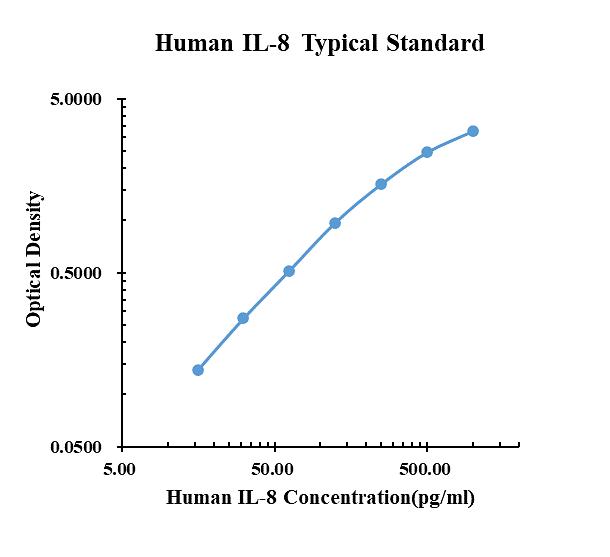
|
pg/ml |
O.D. |
Average |
Corrected |
|
|
0.00 |
0.0373 |
0.0398 |
0.0386 |
|
|
15.63 |
0.1787 |
0.1737 |
0.1762 |
0.1377 |
|
31.25 |
0.3150 |
0.3089 |
0.3120 |
0.2734 |
|
62.50 |
0.5432 |
0.5618 |
0.5525 |
0.5140 |
|
125.00 |
1.0080 |
1.0100 |
1.0090 |
0.9705 |
|
250.00 |
1.7310 |
1.5760 |
1.6535 |
1.6150 |
|
500.00 |
2.5480 |
2.4510 |
2.4995 |
2.4610 |
|
1000.00 |
3.4340 |
3.1610 |
3.2975 |
3.2590 |
- Optimized capture and detection antibody pairings with recommended concentrations save lengthy development time
- Development protocols are provided to guide further assay optimization
- Economical alternative to complete kits
- Capture Antibody
- Detection Antibody
- Recombinant Standard
- Streptavidin conjugated to horseradish-peroxidase (Streptavidin-HRP)
- ARExSet® Ancillary Reagent Kit (5 plates): containing 96 well microplates, plate sealers, substrate solution, stop solution, plate coating buffer (PBS), wash buffer, and assay buffer.
- 96 well microplates: AREX Biosciences, Catalog # DSEP01. Plate Sealers: AREX Biosciences, Catalog # DSSF01.
- Coating Buffer: 137 mM NaCl, 2.7 mM KCl, 8.1 mM Na2HPO4, 1.5 mM KH2PO4, pH 7.2-7.4, 0.2 μm fi
ltered . AREX Biosciences, Catalog # DSCB01. - Blocking Buffer: AREX Biosciences, Catalog # DSBB01.
- Wash Buffer: 0.05% Tween 20 in PBS, pH 7.2-7.4. AREX Biosciences, Catalog # DSWB01.
- Assay Buffer: 0.5%BSA,0.05%Tween20,PBS Solution. AREX Biosciences, Catalog # DSAB01
Substrate Solution: Tetramethylbenzidine. AREX Biosciences, Catalog # DSTS01. - Stop Solution: 0.5mol/ml H2SO4. AREX Biosciences, Catalog # DSSS01.
New Products