Human CD31/PECAM-1 ELISA Kit
Key features and details
- Specification:
- Sensitivity:
- Standard Curve Range:
- Standard Curve Gradient:
- Number of Incubations:
- Sample Volume:
- Assay type:
- Operation Duration:
-
Brand:

CAT.NO. : AEH0192
US$ Please choose
US$ Please choose
Size:
Trail, Bulk size or Custom requests Please contact us
 Product Details
Background
PECAM-1 (Platelet-Endothelial Cell Adhesion Molecule-1), also known as CD31, is a 130 kDa type I transmembrane glycoprotein adhesion molecule in the immunoglobulin superfamily. Expression is restricted to cells involved in circulation, especially endothelial cells, platelets, monocytes, neutrophils and lymphocyte subsets. PECAM-1 is concentrated at cell-cell junctions and is required for Transendothelial Migration (TEM). The Extracellular Domain (ECD) of PECAM-1 has ten potential N-linked glycosylation sites and six C2-type Ig-like domains, the first of which is critical for adhesion and extravasation. The cytoplasmic domain contains Immunoregulatory Tyrosine-based Inhibitory and Switch Motifs (ITIM, ITSM) that mediate both inhibition and activation via phosphotyrosine-mediated engagement of SH2-containing signaling molecules. Metalloproteinase-mediated ectodomain shedding occurs during apoptosis but increased serum PECAM-1 ectodomain in HIV and active multiple sclerosis occurs independent of apoptosis. In humans, expression of six isoforms with exon deletions in the cytoplasmic domain is tissue- and stage-specific, but full-length PECAM-1 is predominant. A form lacking the ITSM predominates in mouse. Mouse PECAM-1 ECD shows 77%, 63%, 63%, 63%, and 61% amino acid (aa) identity with rat, human, canine, porcine, and bovine PECAM-1, respectively. PECAM-1 participates with other adhesion molecules in some functions, but is the critical molecule for TEM. Homotypic PECAM-1 adhesion in trans, combined with cycling of PECAM-1 to and from surface-connected endothelial cell vesicles, leads leukocytes across endothelial tight junctions. Homotypic adhesion and signaling functions also strongly suppress mitochondria-dependent apoptosis. In platelets, PECAM-1 is necessary for limiting thrombus formation and promoting integrin-mediated clot retraction and platelet spreading, but mechanisms for these phenomena are unclear. PECAM-/- mice are deficient in chemokine-mediated chemotaxis .
Typical data
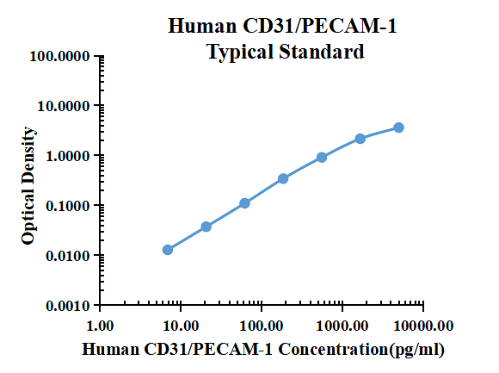
|
pg/ml |
O.D. |
Average |
Corrected |
|
|
0.00 |
0.0081 |
0.0084 |
0.0083 |
|
|
6.86 |
0.0211 |
0.0212 |
0.0212 |
0.0129 |
|
20.58 |
0.0481 |
0.0432 |
0.0457 |
0.0374 |
|
61.73 |
0.1258 |
0.1117 |
0.1188 |
0.1105 |
|
185.19 |
0.3603 |
0.3432 |
0.3518 |
0.3435 |
|
555.56 |
0.9777 |
0.8702 |
0.9240 |
0.9157 |
|
1666.67 |
2.2370 |
2.1020 |
2.1695 |
2.1613 |
|
5000.00 |
3.6500 |
3.6030 |
3.6265 |
3.6183 |
Precision
|
Intra-assay Precision |
Inter-assay Precision |
|||||
|
Sample Number |
S1 |
S2 |
S3 |
S1 |
S2 |
S3 |
|
22 |
22 |
22 |
6 |
6 |
6 |
|
|
Average(pg/ml) |
31.8 |
155.8 |
497.5 |
26.7 |
140.6 |
449.5 |
|
Standard Deviation |
2.0 |
10.6 |
32.4 |
1.9 |
10.0 |
28.1 |
|
Coefficient of Variation(%) |
6.4 |
6.8 |
6.5 |
7 |
7.1 |
6.2 |
Inter-assay Precision (Precision between assays) Three samples of known concentration were tested six times on one plate to assess intra-assay precision.
Spike Recovery
The spike recovery was evaluated by spiking 3 levels of human CD31/PECAM-1 into health human serum sample. The un-spiked serum was used as blank in this experiment.
The recovery ranged from 80% to 118% with an overall mean recovery of 98%.
The recovery ranged from 80% to 118% with an overall mean recovery of 98%.
Sample Values
| Sample Matrix | Sample Evaluated | Range (ng/ml) | Detectable (%) | Mean of Detectable (ng/ml) |
|---|---|---|---|---|
| Serum | 30 | 13.76-23.75 | 100 | 16.93 |
Serum/Plasma – Thirty samples from apparently healthy volunteers were evaluated for the presence of CD31/PECAM-1 in this assay. No medical histories were available for the donors.
New Products