DAXX Rabbit Polyclonal Antibody
Key features and details
- Reactivity:
- Application:
- Host:
- Clonality:
- Target:
-
Brand:

CAT.NO. : ARA6779
US$ Please choose
US$ Please choose
Size:
Trail, Bulk size or Custom requests Please contact us
 Product Details
Background
This gene encodes a multifunctional protein that resides in multiple locations in the nucleus and in the cytoplasm. It interacts with a wide variety of proteins, such as apoptosis antigen Fas, centromere protein C, and transcription factor erythroblastosis virus E26 oncogene homolog 1. In the nucleus, the encoded protein functions as a potent transcription repressor that binds to sumoylated transcription factors. Its repression can be relieved by the sequestration of this protein into promyelocytic leukemia nuclear bodies or nucleoli. This protein also associates with centromeres in G2 phase. In the cytoplasm, the encoded protein may function to regulate apoptosis. The subcellular localization and function of this protein are modulated by post-translational modifications, including sumoylation, phosphorylation and polyubiquitination. Alternative splicing results in multiple transcript variants. [provided by RefSeq, Nov 2008]
Application
|
Application |
Dilution Ratio |
|
IHC-P |
1:50-1:100 |
Overview
|
Immunogen |
KLH-conjugated synthetic peptide encompassing a sequence within the center region of human DAXX. The exact sequence is proprietary. |
|
Purification Method |
The antibody was purified by immunogen affinity chromatography. |
|
Clone Type |
Polyclonal |
|
Product Form |
Liquid in 0.42% Potassium phosphate, 0.87% Sodium chloride, pH 7.3, 30% glycerol, and 0.01% sodium azide. |
|
Gene Name |
DAXX |
|
Related Names |
BING2; DAP6; Death domain-associated protein 6; Daxx; hDaxx; ETS1-associated protein 1; EAP1; Fas death domain-associated protein |
|
Gene ID (Human) |
1616 |
|
Gene ID (Mouse) |
13163 |
|
Protein ID (Human) |
Q9UER7 |
|
Protein ID (Mouse) |
O35613 |
|
Protein ID (Rat) |
Q8VIB2 |
Data
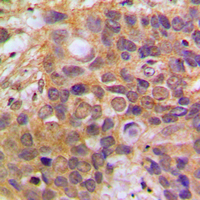
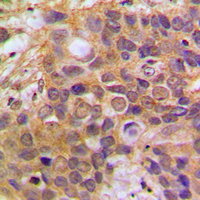
Immunohistochemical staining of human breast cancer tissue using DAXX Rabbit Polyclonal Antibody
Storage
Store at 4°C short term. For long term storage, store at -20°C, avoiding freeze/thaw cycles.
Research Use Only
For Research Use Only. Not for use in diagnostic procedures.
New Products