CXCL12 Rabbit Polyclonal Antibody
 MSDS
MSDS 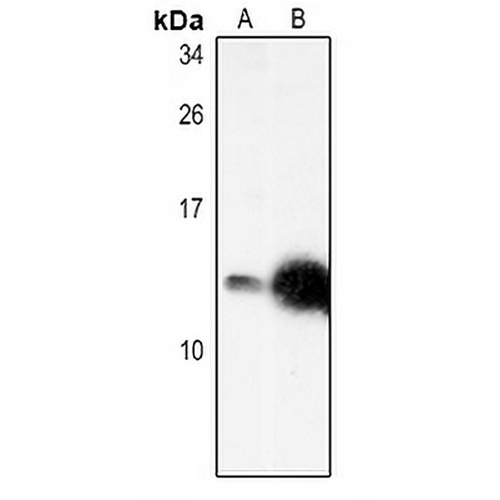
Key features and details
- Target:
- Source/Host:
- Reactivity:
- Clonality:
- Applications:
- Conjugation:
- Storage:
-
Brand:

 Product Details
WB | 1:500 - 1:1000 |
IHC | 1:50 - 1:200 |
IF/ICC | 1:50 - 1:200 |
Description | Rabbit polyclonal antibody to CXCL12 |
Specificity | Recognizes endogenous levels of CXCL12 protein. |
Antibody Type | Primary antibody |
Imnunogen | Recombinant protein corresponding to human CXCL12. The exact sequence is proprietary. |
Purification | The antibody was purified by immunogen affinity chromatography. |
Molecular Weight | Predicted: 11 kD; Observed: 11 kD |
Form/Buffer | Liquid in 0.42% Potassium phosphate, 0.87% Sodium chloride, pH 7.3, 30% glycerol, and 0.01% sodium azide. |
Alternative Names | SDF1; SDF1A; SDF1B; Stromal cell-derived factor 1; SDF-1; hSDF-1; C-X-C motif chemokine 12; Intercrine reduced in hepatomas; IRH; hIRH; Pre-B cell growth-stimulating factor; PBSF |
Gene Symbol | CXCL12 |
Entrez Gene | 6387(Human); 20315(Mouse) |
SwissProt | P48061(Human); P40224(Mouse) |
*Clone Number, Reactivity, Source/Host and Clonality can be found in the product name and Key Features section above.
Western blot analysis of CXCL12 expression in mouse spleen (A), rat spleen (B) whole cell lysates. (Predicted band size: 11 kD; Observed band size: 11 kD)
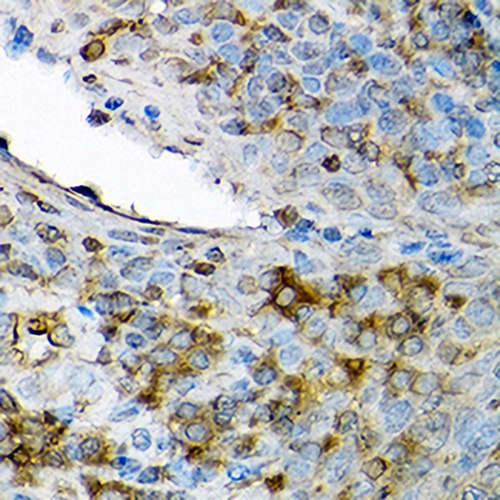
Immunohistochemical analysis of CXCL12 staining in human tonsil formalin fixed paraffin embedded tissue section. The section was pre-treated using heat mediated antigen retrieval with sodium citrate buffer (pH 6.0). The section was then incubated with the antibody at room temperature and detected using an HRP conjugated compact polymer system. DAB was used as the chromogen. The section was then counterstained with haematoxylin and mounted with DPX.
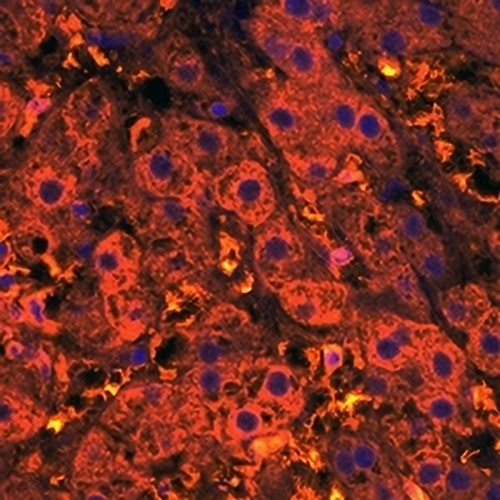
Immunofluorescent analysis of CXCL12 staining in human liver. Formalin-fixed cells were permeabilized with 0.1% Triton X-100 in TBS for 5-10 minutes and blocked with 3% BSA-PBS for 30 minutes at room temperature. Cells were probed with the primary antibody in 3% BSA-PBS and incubated overnight at 4 °C in a humidified chamber. Cells were washed with PBST and incubated with a AREX® Fluor 594-conjugated secondary antibody (red) in PBS at room temperature in the dark. DAPI was used to stain the cell nuclei (blue).
FAQs
 New Products