Beta-galactosidase Rabbit Polyclonal Antibody
Key features and details
- Reactivity:Human, Mouse
- Host:Rabbit
- Clonality:Polyclonal
- Application:WB, IHC
- Target:Beta-galactosidase
-
Brand:

CAT.NO. : APA19557
US$ Please choose
US$ Please choose
 Product Details
Background
Beta Galactosidase encodes a member of the glycosyl hydrolase 35 family of proteins. Alternative splicing results in multiple transcript variants, at least one of which encodes a preproprotein that is proteolytically processed to generate the mature lysosomal enzyme. This enzyme catalyzes the hydrolysis of a terminal beta-linked galactose residue from ganglioside substrates and other glycoconjugates. Mutations in this gene have been associated with GM1-gangliosidosis and Morquio B syndrome. Diseases associated with GLB1 include Gm1-Gangliosidosis, Type I and Gm1-Gangliosidosis, Type Ii.
Application
|
Application |
Dilution Ratio |
|
WB |
1:500 - 1:1000 |
|
IHC |
1:100 - 1:200 |
Overview
|
Product Description |
Rabbit polyclonal antibody to Beta-galactosidase |
|
Immunogen |
KLH-conjugated synthetic peptide encompassing a sequence within the center region of human Beta-galactosidase. The exact sequence is proprietary. |
|
Purification Method |
The antibody was purified by immunogen affinity chromatography. |
|
Clonality |
Polyclonal |
|
Form |
Liquid in 0.42% Potassium phosphate, 0.87% Sodium chloride, pH 7.3, 30% glycerol, and 0.01% sodium azide. |
|
Gene Symbol |
GLB1 |
|
Alternative Names |
ELNR1; Beta-galactosidase; Acid beta-galactosidase; Lactase; Elastin receptor 1 |
|
Gene ID (Human) |
2720 |
|
Gene ID (Mouse) |
12091 |
|
Protein ID (Human) |
P16278 |
|
Protein ID (Mouse) |
P23780 |
Data

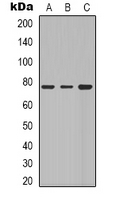
Western blot analysis of Beta-galactosidase expression in Hela (A), A549 (B), NIH3T3 (C) whole cell lysates. (Predicted band size: 76 kD; Observed band size: 76 kD)

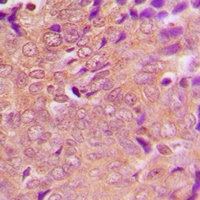
Immunohistochemical analysis of Beta-galactosidase staining in human breast cancer formalin fixed paraffin embedded tissue section. The section was pre-treated using heat mediated antigen retrieval with sodium citrate buffer (pH 6.0). The section was then incubated with the antibody at room temperature and detected using an HRP conjugated compact polymer system. DAB was used as the chromogen. The section was then counterstained with haematoxylin and mounted with DPX.
Storage
Store at 4°C short term. For long term storage, store at -20°C, avoiding freeze/thaw cycles.
Note
For Research Use Only. Not for use in diagnostic procedures.
New Products