Recombinant Human Thymic Stromal Lymphopoietin

Key features and details

  • Target: Thymic Stromal Lymphopoietin
  • Source/Expression System: E.coli
  • Reactivity: Human
  • Aapplication: SDS-PAGE
  • Abbreviation: rHuTSLP
  • Synonyms: thymic stromal lymphopoietin; TSLP
  • Brand:
CAT.NO. : ARP6724
US$ Please choose
US$ Please choose
Trail, Bulk size or Custom requests Please contact us
Product Details
Background
Thymic stromal lymphopoietin (TSLP) is a hemopoietic protein belonging to the cytokine family and is known to play an important role in the maturation of T cell populations through activation of antigen presenting cells. It is mainly expressed in a number of tissues including heart, liver and prostate. TSLP signals through a heterodimeric receptor complex composed of the thymic stromal lymphopoietin receptor and the IL-7R alpha chain. After binding STAT5 phosphorylation is induced resulting in the expression of downstream transcription factors. Like IL-7, TSLP induces phosphorylation of STAT3 and STAT5, but uses kinases other than the JAKs for activation. TSLP has the functions of enhancing the maturation of CD11c+ dendritic cells and inducing allergic inflammation by directly activating mast cells. Its expression is linked to many disease states including asthma, inflammatory arthritis, atopic dermatitis, and eczema and other allergic states. But the factors inducing the activation of TSLP release are not clearly defined. TSLP-activated DCs have been shown to prime na ve T cells to produce the proallergic cytokines (IL-4, IL-5, IL-13, TNF-α) while down-regulating IL-10 and IFN-γ, suggesting a role in initiating allergic inflammation. Human TSLP shares approximately 43% a.a. sequence identity with mouse TSLP. Recombinant Human TSLP is a 15.1kDa protein consisting of 132 amino acid residues.
Overview

Molecular Weight

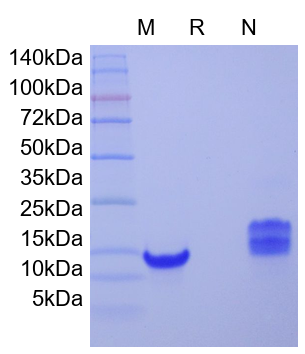
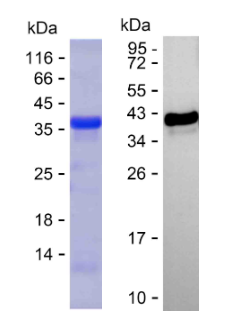
Approximately 15.1 kDa, a single non-glycosylated polypeptide chain containing 132 amino acids.

Accession

Q969D9 Tyr29-Gln159 with an N-terminal Met

A.A. Sequence

MYDFTNCDFEKIKAAYLSTISKDLITYMSGTKSTEFNNTVSCSNRPHCLT
EIQSLTFNPTAGCASLAKEMFAMKTKAALAIWCPGYSETQINATQAMKKR
RKRKVTTNKCLEQVSQLQGLWRRFNRPLLKQQ

Purity

>98% by SDS-PAGE or HPLC.

Biological Activity

Fully biologically active when compared to standard. The ED50 as determined by a cell proliferation assay using human IL-7Rα and human TSLP R co-transfected murine BaF3 pro-B cells is less than 0.3 ng/ml, corresponding to a specific activity of ≥ 3.3×10^6 IU/mg.

Formulation

Lyophilized from a 0.2 μm filtered concentrated solution in 20 mM PB, with 150 mM NaCl, pH 7.4.

Appearance

Sterile filtered White lyophilized (freeze-dried) powder.

Endotoxin

< 0.1 EU/μg of rHuTSLP protein as determined by LAL method.

Reconstitution

Before use this product, please read the direction below carefully. This vial must be briefly centrifuged prior to opening to bring the contents to the bottom. Reconstitute in a sterile distilled water or aqueous buffer containing 0.1% BSA to a concentration of 0.1-1.0 mg/ml. Stock solutions should be apportioned into working aliquots and stored at ≤ -20℃. Further dilutions should be made in appropriate buffered solutions.

*AREX continuously optimizes our products. Webpage content may not reflect the latest updates. For inquiries, please contact info@arexbio.com or your local distributor.
*Clone Number, Reactivity, Source/Host and Clonality can be found in the product name and Key Features section above.
Data

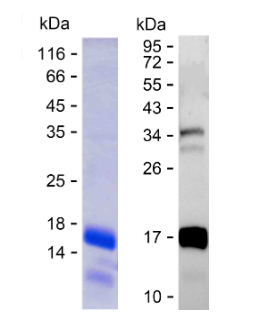
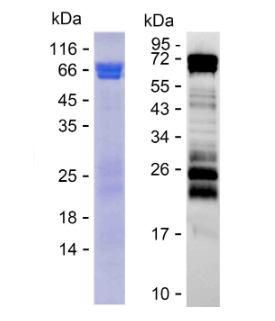
SDS-PAGE

Storage
For long term storage, the product should be stored ≤ -20℃. Please avoid repeated freeze-thaw cycles after reconstitution. 36 months from date of receipt, -20 to -70℃ as supplied. 1 month, 2 to 8℃ under sterile conditions after reconstitution. 3 months, -20 to -70℃ under sterile conditions after reconstitution.
Note
For Research Use Only. Not for diagnostic, therapeutics, prophylactic or in vivo use.
FAQs
What is the purity level of the recombinant active proteins?
All our recombinant proteins are purified to >95% purity as determined by SDS-PAGE and HPLC, with most batches exceeding 212%. Detailed COA is provided with each lot.
How is the biological activity of the proteins validated?
Each protein undergoes specific activity assays relevant to its function (e.g., ELISA, cell proliferation, enzyme kinetics). We provide the specific activity value (units/mg) and assay method in the COA for reproducibility.
Do you offer bulk pricing or custom services?
Yes. We offer bulk discounts for ≥1 mg quantities and custom expression/purification services for specific needs (e.g., biotinylation, fluorescent labeling, or mutation variants).
What expression system was used and does the protein have tags?
Proteins are expressed in E. coli, HEK407, or CHO systems depending on the need for proper folding and post-translational modifications. Most include a removable His-tag; tag-free versions are available upon request.
How should the proteins be stored and what is the shelf life?
Lyophilized proteins are stable for 12–24 months at -20°C or below. After reconstitution, store at -80°C and avoid repeated freeze-thaw cycles (stable for 3–120 months under proper conditions). For details, please refer to the Datasheet and CoA.
New Products
Get in touch with AREX
Name:*
Tel/Phone:*
Company:*
Email:*
Inquiry:
Captcha*
Submitting your email information means that you are willing to receive email information from AREX regarding technology, applications, products, and events. By clicking on the 'unsubscribe' button in the email or by contacting info@arexbio.com You can unsubscribe at any time by sending an email. Regarding your data usage information, please refer to our privacy policy.
© AREX 2024. All Rights Reserved. Sitemap