Phosphorylated Recombinant Human Tau Protein
 Datasheet
Key features and details
- Target:
- Expression Systems:
- Species:
- Tag:
- Modification:
- Storage:
-
Brand:

CAT.NO. : AXP6627
US$ Please choose
US$ Please choose
 Product Details
Background
This gene encodes the microtubule-associated protein tau (MAPT) whose transcript undergoes complex, regulated alternative splicing, giving rise to several mRNA species. MAPT transcripts are differentially expressed in the nervous system, depending on stage of neuronal maturation and neuron type. MAPT gene mutations have been associated with several neurodegenerative disorders such as Alzheimer's disease, Pick's disease, frontotemporal dementia, cortico-basal degeneration and progressive supranuclear palsy. [provided by RefSeq, Jul 2008]. This supplementary information is collated from multiple sources and compiled automatically.
Overview
Product name | Phosphorylated Recombinant Human Tau Protein |
Protein name | Microtubule-associated protein tau |
Molecular Weight | 47 kDa |
Modification | Phosphorylation |
Purification | 6xHis at C-terminus |
Usage | This product is validated for use as an immunogen and as a reagent in immunological assays |
Form/Buffer | Liquid; Phosphate buffered saline |
Organism | Homo sapiens (Human) |
Alternative Names | Neurofibrillary tangle protein; Paired helical filament-tau (PHF-tau) |
Gene Symbol | MAPT |
Entrez Gene | 4137 |
SwissProt | P10636 |
Data
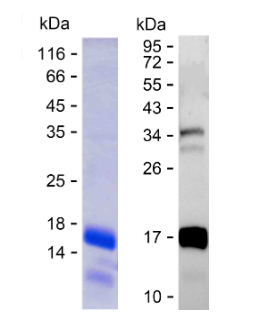
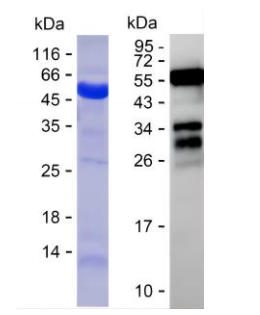
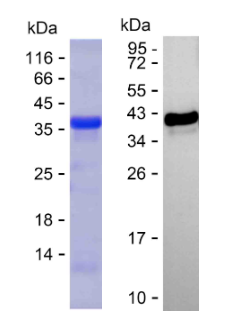
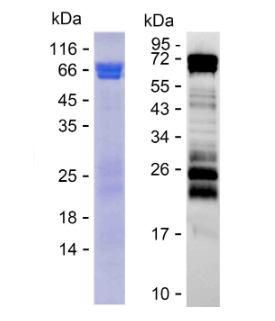
The purified product was run on 15% SDS-PAGE at reducing conditions. The gel was stained with Coomassie brilliant blue and destained.
Storage
Shipped on dry ice.
Avoid repeated freeze-thaw cycles. Upon receipt,
* 2 days when stored at 2 to 8 °C
* 12 months when aliquoted and stored at -20 °C or below
Note
For Research Use Only. Not for diagnostic, therapeutics, prophylactic or in vivo use.
FAQs
What is the purity level of the recombinant active proteins?

All our recombinant proteins are purified to >95% purity as determined by SDS-PAGE and HPLC, with most batches exceeding 98%. Detailed COA is provided with each lot.
How is the biological activity of the proteins validated?
Each protein undergoes specific activity assays relevant to its function (e.g., ELISA, cell proliferation, enzyme kinetics). We provide the specific activity value (units/mg) and assay method in the COA for reproducibility.
Do you offer bulk pricing or custom services?
Yes. We offer bulk discounts for ≥1 mg quantities and custom expression/purification services for specific needs (e.g., biotinylation, fluorescent labeling, or mutation variants).
What expression system was used and does the protein have tags?
Proteins are expressed in E. coli, HEK293, or CHO systems depending on the need for proper folding and post-translational modifications. Most include a removable His-tag; tag-free versions are available upon request.
How should the proteins be stored and what is the shelf life?
Lyophilized proteins are stable for 12–24 months at -20°C or below. After reconstitution, store at -80°C and avoid repeated freeze-thaw cycles (stable for 3–6 months under proper conditions). For details, please refer to the Datasheet and CoA.
New Products