Recombinant Human Monokine Induced by Interferon-gamma/CXCL9

Key features and details

  • Target: Monokine Induced by Interferon-gamma/CXCL9
  • Source/Expression System: E.coli
  • Reactivity: Human
  • Aapplication: SDS-PAGE
  • Abbreviation: rHuMIG/CXCL9
  • Synonyms: Monokine-like Protein
  • Brand:
CAT.NO. : ARP6808
US$ Please choose
US$ Please choose
Trail, Bulk size or Custom requests Please contact us
Product Details
Background
CXCL9 is a T-cell chemoattractant induced by IFN-γ belonging to the CXC chemokine family and it is also known as Monokine induced by gamma interferon (MIG). CXCL9 is closely related to two other CXC chemokines called CXCL10 and CXCL11 and they all elicit their chemotactic functions by interacting with the chemokine receptor CXCR3. CXCL9 is a cytokine that affects the growth, movement, or activation state of cells that participate in immune and inflammatory response and chemotactic for activated T-cells. The human CXCL9 shares 75% and 67% a.a. sequence identity with mouse and rat CXCL9. Recombinant human CXCL9 is a 11.7kDa protein containing 103 amino acid residues.
Overview

Molecular Weight

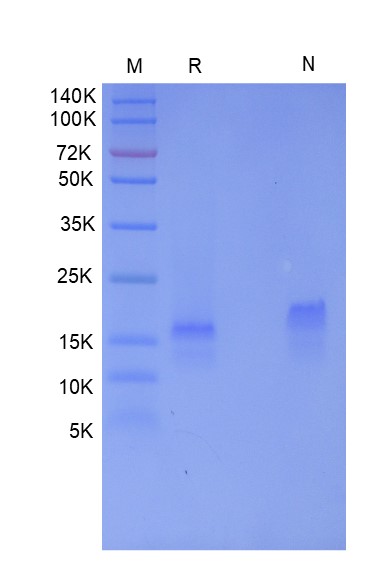
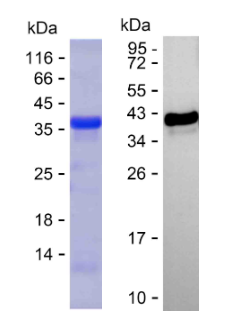
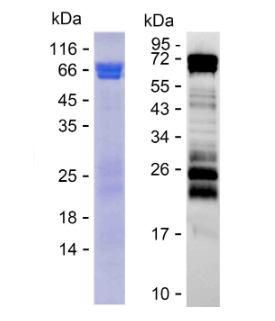
Approximately 11.7 kDa, a single non-glycosylated polypeptide chain containing 103 amino acids.

Accession

Q07325 Thr23-Thr125

A.A. Sequence

TPVVRKGRCSCISTNQGTIHLQSLKDLKQFAPSPSCEKIEIIATLKNGVQ
TCLNPDSADVKELIKKWEKQVSQKKKQKNGKKHQKKKVLKVRKSQRSRQK
KTT

Purity

>98% by SDS-PAGE or HPLC.

Biological Activity

Fully biologically active when compared to standard. The biological activity determined by a chemotaxis bioassay using human peripheral blood T-lymphocytes is in a concentration range of 10-10^0 ng/ml.

Formulation

Lyophilized from a 0.2 μm filtered concentrated solution in 20 mM PB, 50 mM NaCl, pH 7.4

Appearance

Sterile filtered White lyophilized (freeze-dried) powder.

Endotoxin

< 0.1 EU/μg of rHuMIG/CXCL9 protein as determined by LAL method.

Reconstitution

Before use this product, please read the direction below carefully. This vial must be briefly centrifuged prior to opening to bring the contents to the bottom. Reconstitute in sterile distilled water or aqueous buffer containing 0.1% BSA to a concentration of 0.1-1.0mg/ml.  Stock solutions should be apportioned into working aliquots and stored at ≤-20℃. Further dilutions should be made in appropriate buffered solutions.

*AREX continuously optimizes our products. Webpage content may not reflect the latest updates. For inquiries, please contact info@arexbio.com or your local distributor.
*Clone Number, Reactivity, Source/Host and Clonality can be found in the product name and Key Features section above.
Data

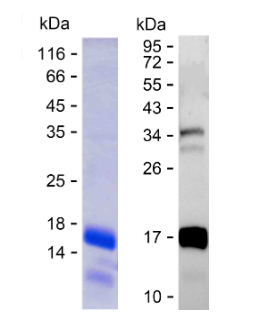
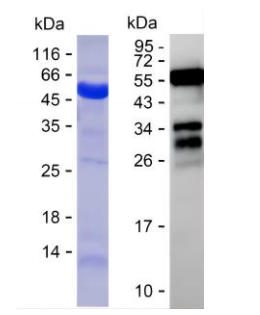
SDS-PAGE

Storage
For long term storage, the product should be stored ≤ -20℃. Please avoid repeated freeze-thaw cycles after reconstitution. 36 months from date of receipt, -20 to -70℃ as supplied. 1 month, 2 to 8℃ under sterile conditions after reconstitution. 3 months, -20 to -70℃ under sterile conditions after reconstitution.
Note
For Research Use Only. Not for diagnostic, therapeutics, prophylactic or in vivo use.
FAQs
What is the purity level of the recombinant active proteins?
All our recombinant proteins are purified to >95% purity as determined by SDS-PAGE and HPLC, with most batches exceeding 296%. Detailed COA is provided with each lot.
How is the biological activity of the proteins validated?
Each protein undergoes specific activity assays relevant to its function (e.g., ELISA, cell proliferation, enzyme kinetics). We provide the specific activity value (units/mg) and assay method in the COA for reproducibility.
Do you offer bulk pricing or custom services?
Yes. We offer bulk discounts for ≥1 mg quantities and custom expression/purification services for specific needs (e.g., biotinylation, fluorescent labeling, or mutation variants).
What expression system was used and does the protein have tags?
Proteins are expressed in E. coli, HEK491, or CHO systems depending on the need for proper folding and post-translational modifications. Most include a removable His-tag; tag-free versions are available upon request.
How should the proteins be stored and what is the shelf life?
Lyophilized proteins are stable for 12–24 months at -20°C or below. After reconstitution, store at -80°C and avoid repeated freeze-thaw cycles (stable for 3–204 months under proper conditions). For details, please refer to the Datasheet and CoA.
New Products
Get in touch with AREX
Name:*
Tel/Phone:*
Company:*
Email:*
Inquiry:
Captcha*
Submitting your email information means that you are willing to receive email information from AREX regarding technology, applications, products, and events. By clicking on the 'unsubscribe' button in the email or by contacting info@arexbio.com You can unsubscribe at any time by sending an email. Regarding your data usage information, please refer to our privacy policy.
© AREX 2024. All Rights Reserved. Sitemap