Recombinant Human 3-Hydroxy-3-methylglutaryl-CoA Reductase, Catalytic Domain

Key features and details

  • Target: 3-Hydroxy-3-methylglutaryl-CoA Reductase, Catalytic Domain
  • Source/Expression System: E.coli
  • Reactivity: Human
  • Aapplication: SDS-PAGE
  • Abbreviation: rHuHMGR
  • Synonyms: HMG-CoA reductase
  • Brand:
CAT.NO. : ARP6772
US$ Please choose
US$ Please choose
Size:
Trail, Bulk size or Custom requests Please contact us
Product Details
Background
3-hydroxy-3-methylglutaryl-coenzyme A reductase (HMGRC) Catalyzes the conversion of (3S) -hydroxy-3-methylglutaryl-CoA (HMG-CoA) to mevalonic acid, the rate-limiting step in the synthesis of cholesterol and other isoprenoids, thus plays a critical role in cellular cholesterol homeostasis. HMGCR is the main target of statins, a class of cholesterol-lowering drugs. Inhibition of HMGCR in the liver stimulates the LDL-receptors, which results in an increased clearance of LDL from the bloodstream and a decrease in blood cholesterol levels, The first result can be seen after one week of statin use and the effect is maximal after four to six weeks. Recombinant human HMGR is a 60.4kDa protein containing  560 amino acid.
Overview

Molecular Weight

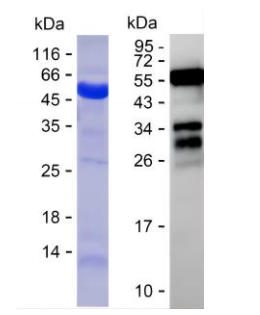
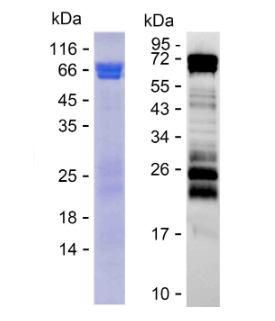
Approximately 60.4 kDa, a single non-glycosylated polypeptide chain containing 560 amino acids.

Accession

P04035 Glu340-Ala888 with a C-terminal flag tag

A.A. Sequence

EQTETESTLSLKNPITSPVVTQKKVPDNCCRREPMLVRNNQKCDSVEEET
GINRERKVEVIKPLVAETDTPNRATFVVGNSSLLDTSSVLVTQEPEIELP
REPRPNEECLQILGNAEKGAKFLSDAEIIQLVNAKHIPAYKLETLMETHE
RGVSIRRQLLSKKLSEPSSLQYLPYRDYNYSLVMGACCENVIGYMPIPVG
VAGPLCLDEKEFQVPMATTEGCLVASTNRGCRAIGLGGGASSRVLADGMT
RGPVVRLPRACDSAEVKAWLETSEGFAVIKEAFDSTSRFARLQKLHTSIA
GRNLYIRFQSRSGDAMGMNMISKGTEKALSKLHEYFPEMQILAVSGNYCT
DKKPAAINWIEGRGKSVVCEAVIPAKVVREVLKTTTEAMIEVNINKNLVG
SAMAGSIGGYNAHAANIVTAIYIACGQDAAQNVGSSNCITLMEASGPTNE
DLYISCTMPSIEIGTVGGGTNLLPQQACLQMLGVQGACKDNPGENARQLA
RIVCGTVMAGELSLMAALAAGHLVKSHMIHNRSKINLQDLQGACTKKTAG
GGSDYKDDDK

Purity

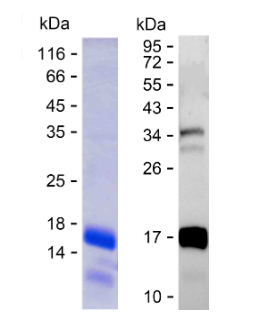
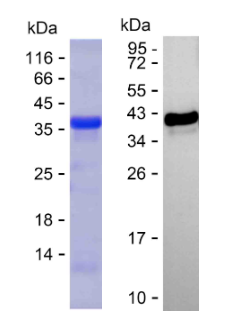
>95% by SDS-PAGE under reducing conditions.

Formulation

A 0.2 μm filtered concentrated solution in 10 mM PB, with 50% (v/v) Glycerol, 2.5 mM DTT, pH 7.4.

Appearance

Sterile colorless liquid.

Concentration

No less than 10mg/ml; The concentration for a specific batch as shown in the COA

Endotoxin

< 0.5 EU/μg of rHuHMGR protein as determined by LAL method.

Reconstitution

Before use this product, please read the direction below carefully. This vial must be briefly centrifuged prior to opening to bring the contents to the bottom. Stock solutions should be apportioned into working aliquots and stored at ≤ -20℃. Further dilutions should be made in appropriate buffered solutions.

Tag

C-terminal Flag Tag

*AREX continuously optimizes our products. Webpage content may not reflect the latest updates. For inquiries, please contact info@arexbio.com or your local distributor.
*Clone Number, Reactivity, Source/Host and Clonality can be found in the product name and Key Features section above.
Storage
For long term storage, the product should be stored ≤ -20℃. Please avoid repeated freeze-thaw cycles after reconstitution. 6 to 12 months from date of receipt, -20 to -70℃ as supplied. 1 month, 2 to 8℃ under sterile conditions after reconstitution. 3 months, -20 to -70℃ under sterile conditions after reconstitution.
Note
For Research Use Only. Not for diagnostic, therapeutics, prophylactic or in vivo use.
FAQs
What is the purity level of the recombinant active proteins?
All our recombinant proteins are purified to >95% purity as determined by SDS-PAGE and HPLC, with most batches exceeding 260%. Detailed COA is provided with each lot.
How is the biological activity of the proteins validated?
Each protein undergoes specific activity assays relevant to its function (e.g., ELISA, cell proliferation, enzyme kinetics). We provide the specific activity value (units/mg) and assay method in the COA for reproducibility.
Do you offer bulk pricing or custom services?
Yes. We offer bulk discounts for ≥1 mg quantities and custom expression/purification services for specific needs (e.g., biotinylation, fluorescent labeling, or mutation variants).
What expression system was used and does the protein have tags?
Proteins are expressed in E. coli, HEK455, or CHO systems depending on the need for proper folding and post-translational modifications. Most include a removable His-tag; tag-free versions are available upon request.
How should the proteins be stored and what is the shelf life?
Lyophilized proteins are stable for 12–24 months at -20°C or below. After reconstitution, store at -80°C and avoid repeated freeze-thaw cycles (stable for 3–168 months under proper conditions). For details, please refer to the Datasheet and CoA.
New Products
Get in touch with AREX
Name:*
Tel/Phone:*
Company:*
Email:*
Inquiry:
Captcha*
Submitting your email information means that you are willing to receive email information from AREX regarding technology, applications, products, and events. By clicking on the 'unsubscribe' button in the email or by contacting info@arexbio.com You can unsubscribe at any time by sending an email. Regarding your data usage information, please refer to our privacy policy.
© AREX 2024. All Rights Reserved. Sitemap