PAFAH1B2 Rabbit Polyclonal Antibody

Key features and details

Rabbit polyclonal antibody to PAFAH1B2
  • Target: PAFAH1B2
  • Source/Host: Rabbit
  • Reactivity: Human,Mouse,Rat
  • Clonality: Polyclonal
  • Applications: WB
  • Conjugation: Unconjugated
  • Storage: at-20°C
  • Brand:
CAT.NO. : APA16403
US$ Please choose
US$ Please choose
Size:
Trail, Bulk size or Custom requests Please contact us
Product Details
Background
Alpha2 catalytic subunit of the cytosolic type I platelet-activating factor (PAF) acetylhydrolase (PAF-AH (I)) heterotetrameric enzyme that catalyzes the hydrolyze of the acetyl group at the sn-2 position of PAF and its analogs and modulates the action of PAF. The activity and substrate specificity of PAF-AH (I) are affected by its subunit composition. The alpha2/alpha2 homodimer (PAFAH1B2/PAFAH1B2 homodimer) hydrolyzes PAF and 1-O-alkyl-2-acetyl-sn-glycero-3-phosphorylethanolamine (AAGPE) more efficiently than 1-O-alkyl-2-acetyl-sn-glycero-3-phosphoric acid (AAGPA). In contrast, the alpha1/alpha2 heterodimer(PAFAH1B3/PAFAH1B3 heterodimer) hydrolyzes AAGPA more efficiently than PAF, but has little hydrolytic activity towards AAGPE .
Application
To ensure optimal assay performance, AREX recommends conducting reagent titration tailored to each testing system for optimal detection results.

WB

1:500 - 1:2000

*Results are sample-specific. Please refer to your local assay conditions and test parameters for reference.
Overview

Description

Rabbit polyclonal antibody to PAFAH1B2

Specificity

Recognizes endogenous levels of PAFAH1B2 protein

Antibody Type

Primary antibody

Imnunogen

Recombinant fusion protein of human PAFAH1B2. The exact sequence is proprietary.

Purification

The antibody was purified by immunogen affinity chromatography.

Molecular Weight

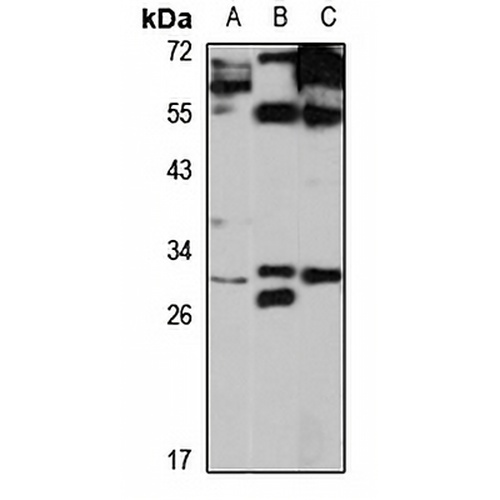
Predicted: 14; Observed: 30 kD

Form/Buffer

Liquid in 0.42% Potassium phosphate, 0.87% Sodium chloride, pH 7.3, 30% glycerol, and 0.01% sodium azide.

Alternative Names

PAFAHB; Platelet-activating factor acetylhydrolase IB subunit beta; PAF acetylhydrolase 30 kDa subunit; PAF-AH 30 kDa subunit; PAF-AH subunit beta; PAFAH subunit beta

Gene Symbol

PAFAH1B2

Entrez Gene

5049(Human); 18475(Mouse); 64189(Rat)

SwissProt

P68402(Human); Q61206(Mouse); O35264(Rat)

*AREX continuously optimizes our products. Webpage content may not reflect the latest updates. For inquiries, please contact info@arexbio.com or your local distributor.
*Clone Number, Reactivity, Source/Host and Clonality can be found in the product name and Key Features section above.
Data

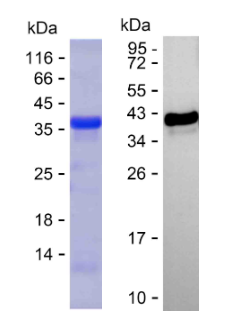
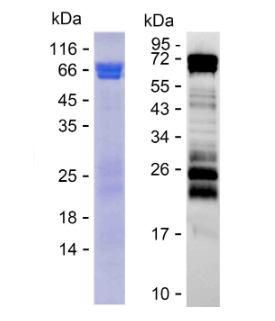
Western blot analysis of PAFAH1B2 expression in HeLa (A), mouse testis (B), rat brain (C) whole cell lysates. (Predicted band size: 14; 17; 22; 25 kD; Observed band size: 30 kD)

Storage
Store at 4°C short term. For long term storage, store at -20°C, avoiding freeze/thaw cycles.
Note
For Research Use Only. Not for diagnostic, therapeutics, prophylactic or in vivo use.
FAQs
What are the main types of research antibodies and how do they differ?
Research antibodies are mainly divided into monoclonal antibodies and polyclonal antibodies. Monoclonal antibodies typically offer higher specificity and better batch-to-batch consistency, while polyclonal antibodies often provide stronger affinity but may show more variation between batches. The choice depends on your specific experimental needs.
How can I tell if a research antibody is suitable for my experiment?
It is recommended to carefully review the product datasheet for validated applications, species reactivity, recommended dilutions, and published references. For new antibodies, performing a small-scale validation with positive control samples is usually helpful.
Can improper storage of research antibodies affect experimental results?
Yes. Antibodies are sensitive to temperature, repeated freeze-thaw cycles, and contamination. Improper storage may lead to reduced activity, increased background, or weaker signals. It is best to follow the storage instructions provided in the product datasheet.
Why doesn’t the recommended dilution in the datasheet work well in my experiment?
The recommended dilution is based on the supplier’s test conditions. Factors such as sample type, fixation method, and detection system in your lab can influence the optimal working concentration. Performing a dilution series optimization in your own system is often necessary.
What precautions should I take when using a newly purchased research antibody for the first time?
It is advisable to briefly centrifuge the antibody (especially concentrated or lyophilized ones), then perform a small-scale pilot experiment using the recommended conditions. Recording the batch number and usage date is also helpful for future tracking.
New Products
Get in touch with AREX
Name:*
Tel/Phone:*
Company:*
Email:*
Inquiry:
Captcha*
Submitting your email information means that you are willing to receive email information from AREX regarding technology, applications, products, and events. By clicking on the 'unsubscribe' button in the email or by contacting info@arexbio.com You can unsubscribe at any time by sending an email. Regarding your data usage information, please refer to our privacy policy.
© AREX 2024. All Rights Reserved. Sitemap