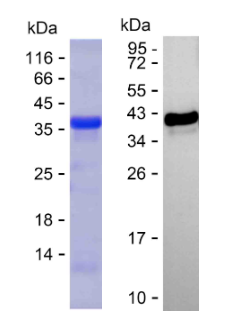
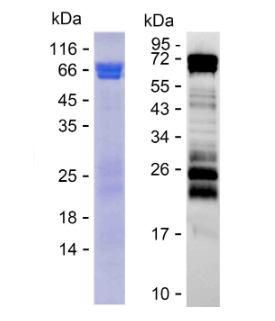
Mouse LIF ARExSet® antibody pair for ELISA

Key features and details

  • Target: LIF
  • Reactivity: Mouse
  • Sample Volume: 10 μl
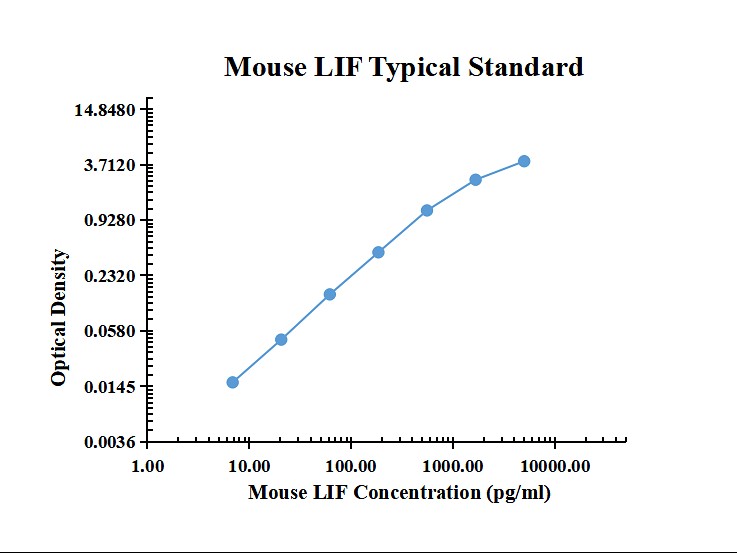
  • Range: 6.86 pg/ml-5000 pg/ml
  • Operation Duration: 120min
  • Brand:
CAT.NO. : ASEM0038
US$ Please choose
US$ Please choose
Trail, Bulk size or Custom requests Please contact us
Product Details
Background
LIF LIF (leukemia inhibitory factor) is a widely expressed, highly and variably glycosylated, 32‑62 kDa, monomeric, pleiotropic cytokine in the IL‑6 family of helical cytokines. The first exon encoding the signal sequence is alternately spliced, resulting in LIF-D, LIF-M, and LIF‑T mRNAs that produce secreted, extracellular matrix‑associated, and intracellular forms, respectively. LIF-D and LIF-M mRNAs produce identical 180 amino acid (aa) mature sequences. Mature human LIF (180 aa) shares 78%, 82%, 91%, 88 and 87% aa sequence identity with mouse, rat, canine, bovine, and porcine LIF, respectively. The LIF receptor is a heterodimer of a type I transmembrane ligand‑binding subunit, LIFR (gp190), and the type I transmembrane signal transducing subunit, gp130, signaling especially through STAT3 and JAK kinases. Gp130 and members of the LIFR family also mediate the biological effects of Oncostatin M, Cardiotrophin‑1, Galectin‑10, CNTF, IL‑6, IL‑11, and IL‑27. A soluble LIFR has been reported in the mouse. Depending on the cells and their context, LIF either opposes or favors differentiation. LIF produced by the uterine endometrium supports successful implantation of the embryo, promotes proliferation and maintenance of pluripotency in embryonic stem cells, and favors proliferation of progenitor cell types such as hematopoietic stem cells. However, excess LIF blocks differentiation of embryoid bodies, indicating the importance of LIF regulation. LIF is produced by CD4+ T cells in response to activation, and is required by the thymic epithelium to support T cell maturation. LIF expression is up‑regulated by neuronal injury, and promotes motor neuron survival and oligodendrocyte myelination. LIF is produced by the adrenal cortex and likely enhances its production of cortisol and aldosterone. LIF can function as an autocrine growth factor in some pancreatic cancers, but induces differentiation in the myeloid leukemic cell line M1. Tumor LIF can also induce forma
Overview

Standard Curve Range

6.86 pg/ml-5000 pg/ml

Standard Curve Gradient

7 Points/3 Folds

Number of Incubations

2

Detectable Sample

Liquid phase sample of soluble substances. For example: serum, plasma, cell culture supernatant, tissue grinding liquid, etc.

Sample Volume

10 μl

Type

Not Ready-to-Use

Operation Duration

120min

Alternative Names

Differentiation-stimulating factor, Melanoma-derived LPL inhibitor

Gene Symbol

LIF, HILDA

Entrez Gene

3976 (Human)

SwissProt

P15018 (Human)

*AREX continuously optimizes our products. Webpage content may not reflect the latest updates. For inquiries, please contact info@arexbio.com or your local distributor.
Data

<table><tr><td>pg/ml</td><td>O.D.1</td><td>O.D.2</td><td>Average</td><td>Corrected</td></tr><tr><td>0.00</td><td>0.0223</td><td>0.0249</td><td>0.0236</td><td></td></tr><tr><td>6.86</td><td>0.0381</td><td>0.0411</td><td>0.0396</td><td>0.0160</td></tr><tr><td>20.58</td><td>0.0690</td><td>0.0714</td><td>0.0702</td><td>0.0466</td></tr><tr><td>61.73</td><td>0.1620</td><td>0.1743</td><td>0.1682</td><td>0.1446</td></tr><tr><td>185.19</td><td>0.4141</td><td>0.4606</td><td>0.4374</td><td>0.4138</td></tr><tr><td>555.56</td><td>1.1500</td><td>1.2570</td><td>1.2035</td><td>1.1799</td></tr><tr><td>1666.67</td><td>2.5200</td><td>2.6130</td><td>2.5665</td><td>2.5429</td></tr><tr><td>5000.00</td><td>4.0471</td><td>4.0829</td><td>4.0650</td><td>4.0414</td></tr></table>

Product Features
• Optimized capture and detection antibody pairings with recommended concentrations save lengthy development time
• Development protocols are provided to guide further assay optimization
• Assay can be customized to your specific needs
• Economical alternative to complete kits
Kit Content
• Capture Antibody
• Detection Antibody
• Recombinant Standard
• Streptavidin conjugated to horseradish-peroxidase (Streptavidin-HRP)
Other Reagents Required
ARExSet® Ancillary Reagent Kit (5 plates): containing 96 well microplates, plate sealers, substrate solution, stop solution, plate coating buffer (PBS), wash buffer, and assay buffer. The components listed above may be purchased separately:
• 96 well microplates: AREX Biosciences, Catalog # DSEP01.
• Plate Sealers: AREX Biosciences, Catalog # DSSF01.
• Coating Buffer: 137 mM NaCl, 2.7 mM KCl, 8.1 mM Na2HPO4, 1.5 mM KH2PO4, pH 7.2-7.4, 0.2 μm filtered. AREX Biosciences, Catalog # DSCB01.
• Blocking Buffer: AREX Biosciences, Catalog # DSBB01.
• Wash Buffer: 0.05% Tween 20 in PBS, pH 7.2-7.4. AREX Biosciences, Catalog # DSWB01.
• Assay Buffer: 0.5%BSA,0.05%Tween20,PBS Solution.AREX Biosciences, Catalog # DSAB01
• Substrate Solution: Tetramethylbenzidine. AREX Biosciences, Catalog # DSTS01.
• Stop Solution: 0.5mol/L H2SO4. AREX Biosciences, Catalog # DSSS01.
Storage
Store components at 4°C or -20°C. Keep microplate wells sealed in a dry bag with desiccants. Do not expose test reagents to heat, sun or strong light during storage and usage. Please refer to the product user manual for detail temperatures of the components.
Note
For Research Use Only. Not for diagnostic, therapeutics, prophylactic or in vivo use.
FAQs
What is the ARExSet® antibody pair for ELISA?
The ARExSet® antibody pair for ELISA is a Do-It-Yourself (DIY) ELISA reagent set containing optimized capture and detection antibody pairs, recombinant standard, and Streptavidin-HRP. It is designed for researchers who need flexibility in developing their own sandwich ELISA assays.
What sample types can be used with the ARExSet® antibody pair?
Suitable samples typically include serum, plasma, cell culture supernatant, tissue grinding liquid, and other liquid phase samples of soluble substances.
How should the ARExSet® antibody pair be stored?
Store components at 4°C or -20°C upon receipt. Reconstituted standards should be used immediately or stored at -20°C. Avoid repeated freeze/thaw cycles.
What other reagents are required to use the ARExSet® antibody pair?
The ARExSet® Ancillary Reagent Kit is required, containing 96-well microplates, plate sealers, coating buffer, blocking buffer, wash buffer, assay buffer, substrate solution, and stop solution. These can be purchased separately.
Can the assay be customized?
Yes. The assay can be customized to your specific needs. Development protocols are provided to guide further assay optimization. The optimized capture and detection antibody pairings save lengthy development time.
New Products
Get in touch with AREX
Name:*
Tel/Phone:*
Company:*
Email:*
Inquiry:
Captcha*
Submitting your email information means that you are willing to receive email information from AREX regarding technology, applications, products, and events. By clicking on the 'unsubscribe' button in the email or by contacting info@arexbio.com You can unsubscribe at any time by sending an email. Regarding your data usage information, please refer to our privacy policy.
© AREX 2024. All Rights Reserved. Sitemap