Human WNT7A ELISA Kit

Key features and details

  • Target: WNT7A
  • Reactivity: Human
  • Range: 40.96-10000 pg/ml
  • Sensitivity: 3.62 pg/ml (50 μl);7.94 pg/ml (10 μl);
  • Assay type Sandwich Elisa
  • Storage at 2 ~8°C
  • Brand:
CAT.NO. : AEH0312
US$ Please choose
US$ Please choose
Size:
Trail, Bulk size or Custom requests Please contact us
Product Details
Background
Human Wnt-7a is one of about 19 vertebrate members of the Wingless-type MMTV integration site (Wnt) family of highly conserved cysteine-rich secreted glycoproteins important for normal developmental processes. Wnts bind to receptors of the Frizzled family in conjunction with low-density lipoprotein receptor‑related proteins (LRPs). Downstream effects of Wnt signaling occur through activation of one of three different intracellular pathways: the canonical Wnt pathway, Wnt/Ca2+ pathway, and planar cell polarity. The highly transforming Wnts, including Wnt-1, -3, -3a, -7a and -8 activate the canonical pathway, which regulates beta ‑catenin-mediated gene expression. Human Wnt‑7a is a 48 kDa secreted glycoprotein containing 24 cysteine residues that is expressed by epithelial and epithelially-derived cells of the placenta, kidney, testis, uterus, fetal lung, and fetal and adult brain. Palmitate modification of a cysteine residue has been shown for Wnt‑3a; this site is conserved on all Wnts and is Cys73 on Wnt‑7a. When modified, increased hydrophobicity and activity is expected. Human Wnt‑7a shows 97% aa identity with mouse, rat, and dog Wnt‑7a and 92% aa identity with chicken Wnt‑7a. During development, Wnt‑7a is expressed by the dorsal ectoderm and drives expression of homeodomain transcription factors that control effectors important in patterning and cell fates in adjacent mesenchyme. When Wnt‑7a is deleted, mice show disruption of dorsalization and anterior/posterior patterning during limb development and abnormalities in the reproductive tract. Wnt‑7a is frequently downregulated in leukemia and lung cancers, potentially affecting homeobox (HOX) gene expression, differentiation state and growth control. Roles for Wnt‑7a have also been shown during formation of neural synapses, response of the uterus to estrogen and inflammatory cartilage destruction. Wnt-7b is a 46 kDa, secreted glycosylated protein that belongs to the Wnt family. Wnt proteins can be lipid-modified and are ligands for members of the frizzled family of receptors, which mediates cell-cell communication during development. Human Wnt-7b is synthesized as a 349 amino acid (aa) precursor that contains a 318 aa mature region. The mature region contains 24 cysteines and three potential N-linked glycosylation sites. Wnt-7b is a ligand for members of the frizzled family of seven transmembrane receptors. Probable developmental protein. May be a signaling molecule which affects the development of discrete regions of tissues. Is likely to signal over only few cell diameters. Mature human Wnt-7b shares 99% aa sequence identity with mature mouse and rat Wnt-7b. Wnt-7b also shares 80% aa sequence identity with Wnt-7a.
Overview

Sensitivity

3.62 pg/ml (50 μl);7.94 pg/ml (10 μl);

Standard Curve Range

40.96-10000 pg/ml

Standard Curve Gradient

7 Points

Number of Incubations

2

Detectable Sample

Liquid phase sample of soluble substances. For example: serum, plasma, cell culture supernatant, tissue grinding liquid, etc.

Sample Volume

50 μl/10 μl

Type

Fully Ready-to-Use

Operation Duration

120min

Alternative Names

Protein Wnt-7a

Gene Symbol

WNT7A

Entrez Gene

7476 (Human)

SwissProt

O00755 (Human)

*AREX continuously optimizes our products. Webpage content may not reflect the latest updates. For inquiries, please contact info@arexbio.com or your local distributor.
Data

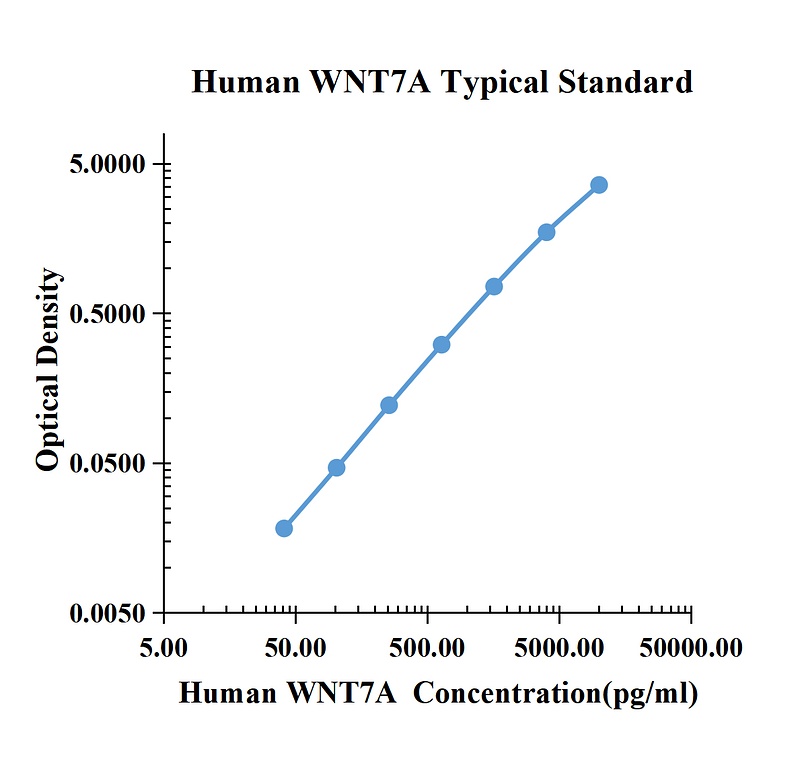
<table><tr><td>pg/ml</td><td>O.D.1</td><td>O.D.2</td><td>Average</td><td>Corrected</td></tr><tr><td>0.00</td><td>0.0164</td><td>0.0152</td><td>0.0158</td><td></td></tr><tr><td>40.96</td><td>0.0351</td><td>0.0332</td><td>0.0342</td><td>0.0184</td></tr><tr><td>102.40</td><td>0.0619</td><td>0.0631</td><td>0.0625</td><td>0.0467</td></tr><tr><td>256.00</td><td>0.1375</td><td>0.1384</td><td>0.1380</td><td>0.1222</td></tr><tr><td>640.00</td><td>0.3264</td><td>0.3251</td><td>0.3258</td><td>0.3100</td></tr><tr><td>1600.00</td><td>0.7644</td><td>0.7827</td><td>0.7736</td><td>0.7578</td></tr><tr><td>4000.00</td><td>1.7650</td><td>1.7600</td><td>1.7625</td><td>1.7467</td></tr><tr><td>10000.00</td><td>3.6480</td><td>3.6180</td><td>3.6330</td><td>3.6172</td></tr></table>

Precision
Intra-assay Precision Inter-assay Precision
Sample Number S1 S2 S3 S1 S2 S3
22 22 22 6 6 6
Average(pg/ml) 138.8 772.3 2512.3 226.3 1112.0 3465.9
Standard Deviation 10.5 40.6 169.6 14.9 20.6 123.0
Coefficient of Variation(%) 7.6 5.3 6.8 6.6 1.9 3.5

Intra-assay Precision (Precision within an assay) Three samples of known concentration were tested twenty-two times on one plate to assess intra-assay precision.

Inter-assay Precision (Precision between assays) Three samples of known concentration were tested six times on one plate to assess intra-assay precision.

Spike Recovery

The spike recovery was evaluated by spiking 3 levels of human WNT7A into health human serum sample. The un-spiked serum was used as blank in this experiment. The recovery ranged from 81% to 109% with an overall mean recovery of 94%.

Sample Values
Sample Matrix Sample Evaluated Range (pg/ml) Detectable (%) Mean of Detectable (pg/ml)
Serum30n.d.-1.9231.251.26

n.d. = non-detectable. Samples measured below the sensitivity are considered to be non-detectable.

Storage
Store components at 4°C or -20°C. Keep microplate wells sealed in a dry bag with desiccants. Do not expose test reagents to heat, sun or strong light during storage and usage. Please refer to the product user manual for detail temperatures of the components.
Note
For Research Use Only. Not for diagnostic, therapeutics, prophylactic or in vivo use.
FAQs
What is the principle of these ELISA kits?
The kits are based on the sandwich or competitive ELISA principle, using specific antibodies and enzyme-conjugated detection for quantitative measurement of the target analyte.
What sample types can be used with the ELISA kits?
Suitable samples typically include serum, plasma, cell culture supernatant, tissue homogenates, and other biological fluids. Please check the specific Datasheet for recommended sample types.
How should the kits be stored and what is the shelf life?
Store components at 4°C or -20°C. Keep microplate wells sealed in a dry bag with desiccants. Do not expose test reagents to heat, sun or strong light during storage and usage. Please refer to the product user manual for detail temperatures of the components.
What is the precision and reproducibility of the kits?
The kits are optimized for good intra- and inter-assay precision when performed according to the protocol. Coefficient of variation (CV) values are generally low.
Do you provide technical support or troubleshooting guidance?
Yes. We provide detailed Datasheets, Certificates of Analysis (CoA), and technical support to help with assay performance and troubleshooting.
New Products
Get in touch with AREX
Name:*
Tel/Phone:*
Company:*
Email:*
Inquiry:
Captcha*
Submitting your email information means that you are willing to receive email information from AREX regarding technology, applications, products, and events. By clicking on the 'unsubscribe' button in the email or by contacting info@arexbio.com You can unsubscribe at any time by sending an email. Regarding your data usage information, please refer to our privacy policy.
© AREX 2024. All Rights Reserved. Sitemap