Background
nterleukin 4 (IL-4) is a pleiotropic cytokine produced by activated T cells, mast cells, and basophils. The biological functions of IL-4 are mediated by the binding of IL‑4 to high-affinity cell surface receptor complexes. Two types of IL-4 receptor complexes have been described. The type I IL-4 receptor complex is composed of a high-affinity IL-4-binding subunit (referred to as IL-4 R alpha ) and the common gamma chain that does not bind IL-4 by itself. The type II IL-4 receptor complex is composed of IL-4 R alpha and IL-13 R alpha 1. Besides IL-4 signals, the type II IL-4 receptor complex can also transduce IL-13 signals. In the type II complex, the IL-4 R alpha subunit binds only IL-4 and not IL-13. Similarly, the IL-13 R alpha 1 subunit binds only IL-13 and not IL-4. The cDNA clones for both the human and mouse IL-4 R alpha have been isolated and shown to encode an approximately 140 kDa type I transmembrane protein with a large cytoplasmic domain that is essential for signal transduction. In mouse cells, an alternatively spliced variant encoding a soluble secreted IL-4 R alpha isoform has also been identified. Naturally occurring soluble IL-4 R alpha that binds IL-4 with high-affinity has been found in mouse and human biological fluids.
Overview
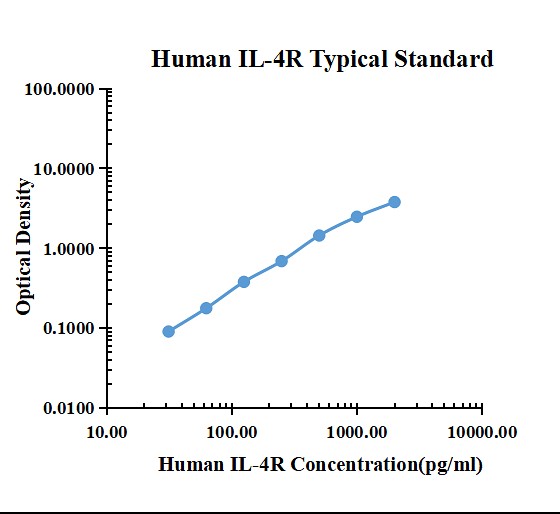
Standard Curve Range | 31.25 pg/ml -2000 pg/ml |
Standard Curve Gradient | 7 Points/3 Folds |
Number of Incubations | 2 |
Detectable Sample | Liquid phase sample of soluble substances. For example: serum, plasma, cell culture supernatant, tissue grinding liquid, etc. |
Sample Volume | 50 μl |
Type | Not Ready-to-Use |
Operation Duration | 120min |
Alternative Names | CD124, IL-4RA, IL4RA, interleukin-4 receptor subunit alpha, IL-4 receptor subunit alpha, interleukin 13 receptor, interleukin-4 receptor alpha chain |
Gene Symbol | IL4R, IL4RA |
Entrez Gene | 3566 (Human) |
SwissProt | P24394 (Human) |
*AREX continuously optimizes our products. Webpage content may not reflect the latest updates. For inquiries, please contact info@arexbio.com or your local distributor.
Data

<table><tr><td>pg/ml</td><td>O.D.1</td><td>O.D.2</td><td>Average</td><td>Corrected</td></tr><tr><td>0.00</td><td>0.0200</td><td>0.0262</td><td>0.0231</td><td></td></tr><tr><td>31.25</td><td>0.1110</td><td>0.1168</td><td>0.1139</td><td>0.0904</td></tr><tr><td>62.50</td><td>0.1832</td><td>0.2181</td><td>0.2007</td><td>0.1771</td></tr><tr><td>125.00</td><td>0.4203</td><td>0.3837</td><td>0.4020</td><td>0.3785</td></tr><tr><td>250.00</td><td>0.6983</td><td>0.7266</td><td>0.7125</td><td>0.6889</td></tr><tr><td>500.00</td><td>1.5120</td><td>1.4200</td><td>1.4660</td><td>1.4425</td></tr><tr><td>1000.00</td><td>2.4170</td><td>2.5860</td><td>2.5015</td><td>2.4780</td></tr><tr><td>2000.00</td><td>3.7160</td><td>3.9070</td><td>3.8115</td><td>3.7880</td></tr></table>
Product Features
• Optimized capture and detection antibody pairings with recommended concentrations save lengthy development time
• Development protocols are provided to guide further assay optimization
• Assay can be customized to your specific needs
• Economical alternative to complete kits
Kit Content
• Capture Antibody
• Detection Antibody
• Recombinant Standard
• Streptavidin conjugated to horseradish-peroxidase (Streptavidin-HRP)
Other Reagents Required
ARExSet® Ancillary Reagent Kit (5 plates): containing 96 well microplates, plate sealers, substrate solution, stop solution, plate coating buffer (PBS), wash buffer, and assay buffer. The components listed above may be purchased separately:
• 96 well microplates: AREX Biosciences, Catalog # DSEP01.
• Plate Sealers: AREX Biosciences, Catalog # DSSF01.
• Coating Buffer: 137 mM NaCl, 2.7 mM KCl, 8.1 mM Na2HPO4, 1.5 mM KH2PO4, pH 7.2-7.4, 0.2 μm filtered. AREX Biosciences, Catalog # DSCB01.
• Blocking Buffer: AREX Biosciences, Catalog # DSBB01.
• Wash Buffer: 0.05% Tween 20 in PBS, pH 7.2-7.4. AREX Biosciences, Catalog # DSWB01.
• Assay Buffer: 0.5%BSA,0.05%Tween20,PBS Solution.AREX Biosciences, Catalog # DSAB01
• Substrate Solution: Tetramethylbenzidine. AREX Biosciences, Catalog # DSTS01.
• Stop Solution: 0.5mol/L H2SO4. AREX Biosciences, Catalog # DSSS01.
Storage
Store components at 4°C or -20°C. Keep microplate wells sealed in a dry bag with desiccants. Do not expose test reagents to heat, sun or strong light during storage and usage. Please refer to the product user manual for detail temperatures of the components.
Note
For Research Use Only. Not for diagnostic, therapeutics, prophylactic or in vivo use.