Background
Interferon-gamma (IFN-gamma), also known as type II or immune interferon, exerts a wide range of immunoregulatory activities and is considered to be the prototype proinflammatory cytokine. Mature human IFN-gamma exists as a non-covalently linked homodimer of 20-25 kDa variably glycosylated subunits. It shares 90% amino acid (aa) sequence identity with rhesus IFN-gamma, 59%‑64% with bovine, canine, equine, feline, and porcine IFN‑ gamma, and 37%‑43% with cotton rat, mouse, and rat IFN-gamma. IFN-gamma dimers bind to IFN-gamma RI (alpha subunits) which then interact with IFN-gamma RII (beta subunits) to form the functional receptor complex of two alpha and two beta subunits. Inclusion of IFN-gamma RII increases the binding affinity for ligand and the efficiency of signal transduction. IFN-gamma is produced by a variety of immune cells under inflammatory conditions, notably by T cells and NK cells. It plays a key role in host defense by promoting the development and activation of Th1 cells, chemoattraction and activation of monocytes and macrophages, up‑regulation of antigen presentation molecules, and immunoglobulin class switching in B cells. It also exhibits antiviral, antiproliferative, and apoptotic effects. In addition, IFN-gamma functions as an anti-inflammatory mediator by promoting the development of regulatory T cells and inhibiting Th17 cell differentiation. The pleiotropic effects of IFN-gamma contribute to the development of multiple aspects of atherosclerosis.
Interferon-gamma (IFN-gamma), also known as type II or immune interferon, exerts a wide range of immunoregulatory activities and is considered to be the prototype proinflammatory cytokine. Mature human IFN-gamma exists as a non-covalently linked homodimer of 20-25 kDa variably glycosylated subunits. It shares 90% amino acid (aa) sequence identity with rhesus IFN-gamma, 59%‑64% with bovine, canine, equine, feline, and porcine IFN‑ gamma, and 37%‑43% with cotton rat, mouse, and rat IFN-gamma. IFN-gamma dimers bind to IFN-gamma RI (alpha subunits) which then interact with IFN-gamma RII (beta subunits) to form the functional receptor complex of two alpha and two beta subunits. Inclusion of IFN-gamma RII increases the binding affinity for ligand and the efficiency of signal transduction. IFN-gamma is produced by a variety of immune cells under inflammatory conditions, notably by T cells and NK cells. It plays a key role in host defense by promoting the development and activation of Th1 cells, chemoattraction and activation of monocytes and macrophages, up‑regulation of antigen presentation molecules, and immunoglobulin class switching in B cells. It also exhibits antiviral, antiproliferative, and apoptotic effects. In addition, IFN-gamma functions as an anti-inflammatory mediator by promoting the development of regulatory T cells and inhibiting Th17 cell differentiation. The pleiotropic effects of IFN-gamma contribute to the development of multiple aspects of atherosclerosis.
Overview
Standard Curve Range | 9.38 pg/ml-600pg/ml |
Standard Curve Gradient | 7 Points/3 Folds |
Number of Incubations | 2 |
Detectable Sample | Liquid phase sample of soluble substances. For example: serum, plasma, cell culture supernatant, tissue grinding liquid, etc. |
Sample Volume | 50 μl |
Type | Not Ready-to-Use |
Operation Duration | 120min |
Alternative Names | Immune interferon |
Gene Symbol | IFNG |
Entrez Gene | 3458 (Human) |
SwissProt | P01579 (Human) |
*AREX continuously optimizes our products. Webpage content may not reflect the latest updates. For inquiries, please contact info@arexbio.com or your local distributor.
Data
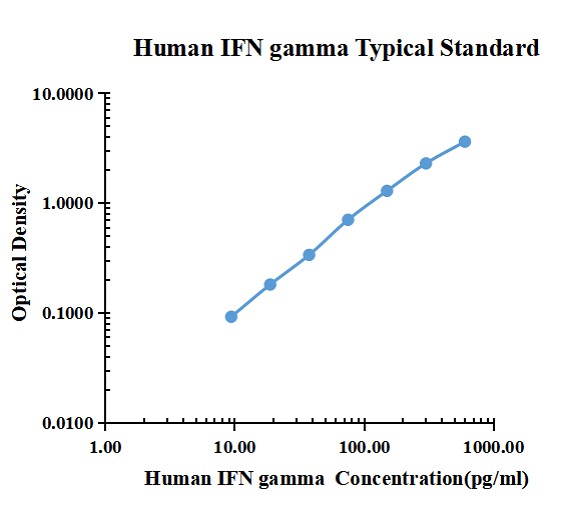
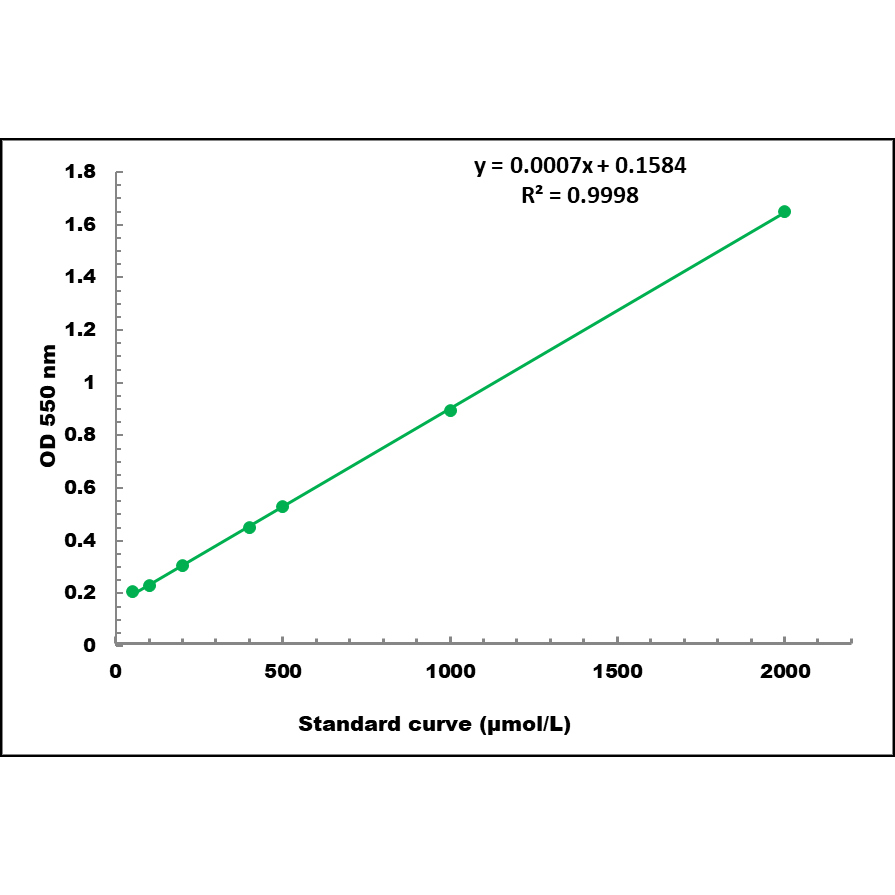
<table><tr><td>pg/ml</td><td>O.D.1</td><td>O.D.2</td><td>Average</td><td>Corrected</td></tr><tr><td>0.00</td><td>0.0133</td><td>0.0117</td><td>0.0125</td><td></td></tr><tr><td>9.38</td><td>0.1031</td><td>0.1072</td><td>0.1052</td><td>0.0927</td></tr><tr><td>18.75</td><td>0.1913</td><td>0.1975</td><td>0.1944</td><td>0.1819</td></tr><tr><td>37.50</td><td>0.3300</td><td>0.3718</td><td>0.3509</td><td>0.3384</td></tr><tr><td>75.00</td><td>0.7144</td><td>0.7221</td><td>0.7183</td><td>0.7058</td></tr><tr><td>150.00</td><td>1.2980</td><td>1.3150</td><td>1.3065</td><td>1.2940</td></tr><tr><td>300.00</td><td>2.2590</td><td>2.3650</td><td>2.3120</td><td>2.2995</td></tr><tr><td>600.00</td><td>3.6480</td><td>3.6260</td><td>3.6370</td><td>3.6245</td></tr></table>
Product Features
• Optimized capture and detection antibody pairings with recommended concentrations save lengthy development time
• Development protocols are provided to guide further assay optimization
• Assay can be customized to your specific needs
• Economical alternative to complete kits
Kit Content
• Capture Antibody
• Detection Antibody
• Recombinant Standard
• Streptavidin conjugated to horseradish-peroxidase (Streptavidin-HRP)
Other Reagents Required
ARExSet® Ancillary Reagent Kit (5 plates): containing 96 well microplates, plate sealers, substrate solution, stop solution, plate coating buffer (PBS), wash buffer, and assay buffer. The components listed above may be purchased separately:
• 96 well microplates: AREX Biosciences, Catalog # DSEP01.
• Plate Sealers: AREX Biosciences, Catalog # DSSF01.
• Coating Buffer: 137 mM NaCl, 2.7 mM KCl, 8.1 mM Na2HPO4, 1.5 mM KH2PO4, pH 7.2-7.4, 0.2 μm filtered. AREX Biosciences, Catalog # DSCB01.
• Blocking Buffer: AREX Biosciences, Catalog # DSBB01.
• Wash Buffer: 0.05% Tween 20 in PBS, pH 7.2-7.4. AREX Biosciences, Catalog # DSWB01.
• Assay Buffer: 0.5%BSA,0.05%Tween20,PBS Solution.AREX Biosciences, Catalog # DSAB01
• Substrate Solution: Tetramethylbenzidine. AREX Biosciences, Catalog # DSTS01.
• Stop Solution: 0.5mol/L H2SO4. AREX Biosciences, Catalog # DSSS01.
Storage
Store components at 4°C or -20°C. Keep microplate wells sealed in a dry bag with desiccants. Do not expose test reagents to heat, sun or strong light during storage and usage. Please refer to the product user manual for detail temperatures of the components.
Note
For Research Use Only. Not for diagnostic, therapeutics, prophylactic or in vivo use.


 Instruction

 Product Details