Background
Epithelial (E)‑Cadherin (ECAD), also known as cell-CAM120/80 in the human, uvomorulin in the mouse, Arc-1 in the dog, and L-CAM in the chicken, is a member of the cadherin family of cell adhesion molecules. Cadherins are calcium-dependent transmembrane proteins, which bind to one another in a homophilic manner. On their cytoplasmic side, they associate with the three catenins, alpha, beta, and gamma (plakoglobin). This association links the cadherin protein to the cytoskeleton. Without association with the catenins, the cadherins are non-adhesive. Cadherins play a role in development, specifically in tissue formation. They may also help to maintain tissue architecture in the adult. E-Cadherin may also play a role in tumor development, as loss of E-Cadherin has been associated with tumor invasiveness. E-Cadherin is a classical cadherin molecule. Classical cadherins consist of a large extracellular domain which contains DXD and DXNDN repeats responsible for mediating calcium‑dependent adhesion, a single-pass transmembrane domain, and a short carboxy-terminal cytoplasmic domain responsible for interacting with the catenins. E‑Cadherin contains five extracellular calcium-binding domains of approximately 110 amino acids each.
Overview
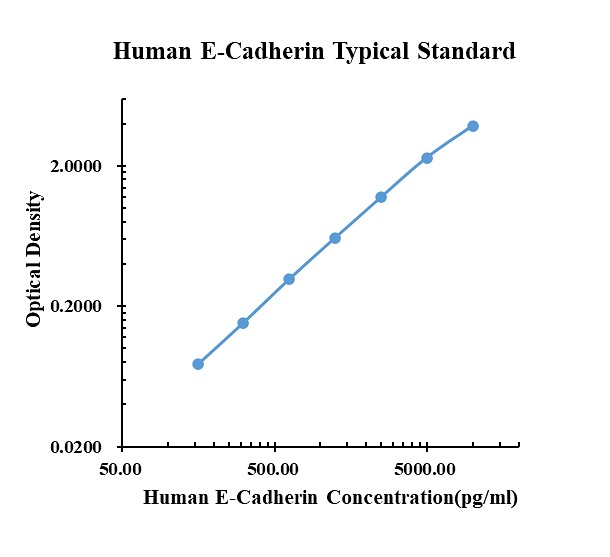
Standard Curve Range | 156.25pg/ml-10000pg/ml |
Standard Curve Gradient | 7 Points/3 Folds |
Number of Incubations | 2 |
Detectable Sample | Liquid phase sample of soluble substances. For example: serum, plasma, cell culture supernatant, tissue grinding liquid, etc. |
Sample Volume | 50 μl |
Type | Not Ready-to-Use |
Operation Duration | 120min |
Alternative Names | CAM 120/80, Epithelial cadherin, Uvomorulin |
Gene Symbol | CDH1, CDHE, UVO |
Entrez Gene | 999 (Human) |
SwissProt | P12830 (Human) |
*AREX continuously optimizes our products. Webpage content may not reflect the latest updates. For inquiries, please contact info@arexbio.com or your local distributor.
Data

<table><tr><td>pg/ml</td><td>O.D.1</td><td>O.D.2</td><td>Average</td><td>Corrected</td></tr><tr><td>0.00</td><td>0.0665</td><td>0.0748</td><td>0.0707</td><td></td></tr><tr><td>156.25</td><td>0.1503</td><td>0.1450</td><td>0.1477</td><td>0.0770</td></tr><tr><td>312.50</td><td>0.2155</td><td>0.2317</td><td>0.2236</td><td>0.1530</td></tr><tr><td>625.00</td><td>0.3866</td><td>0.3801</td><td>0.3834</td><td>0.3127</td></tr><tr><td>1250.00</td><td>0.7045</td><td>0.6662</td><td>0.6854</td><td>0.6147</td></tr><tr><td>2500.00</td><td>1.3060</td><td>1.2270</td><td>1.2665</td><td>1.1959</td></tr><tr><td>5000.00</td><td>2.3420</td><td>2.3810</td><td>2.3615</td><td>2.2909</td></tr><tr><td>10000.00</td><td>3.9270</td><td>3.9290</td><td>3.9280</td><td>3.8574</td></tr></table>
Product Features
• Optimized capture and detection antibody pairings with recommended concentrations save lengthy development time
• Development protocols are provided to guide further assay optimization
• Assay can be customized to your specific needs
• Economical alternative to complete kits
Kit Content
• Capture Antibody
• Detection Antibody
• Recombinant Standard
• Streptavidin conjugated to horseradish-peroxidase (Streptavidin-HRP)
Other Reagents Required
ARExSet® Ancillary Reagent Kit (5 plates): containing 96 well microplates, plate sealers, substrate solution, stop solution, plate coating buffer (PBS), wash buffer, and assay buffer. The components listed above may be purchased separately:
• 96 well microplates: AREX Biosciences, Catalog # DSEP01.
• Plate Sealers: AREX Biosciences, Catalog # DSSF01.
• Coating Buffer: 137 mM NaCl, 2.7 mM KCl, 8.1 mM Na2HPO4, 1.5 mM KH2PO4, pH 7.2-7.4, 0.2 μm filtered. AREX Biosciences, Catalog # DSCB01.
• Blocking Buffer: AREX Biosciences, Catalog # DSBB01.
• Wash Buffer: 0.05% Tween 20 in PBS, pH 7.2-7.4. AREX Biosciences, Catalog # DSWB01.
• Assay Buffer: 0.5%BSA,0.05%Tween20,PBS Solution.AREX Biosciences, Catalog # DSAB01
• Substrate Solution: Tetramethylbenzidine. AREX Biosciences, Catalog # DSTS01.
• Stop Solution: 0.5mol/L H2SO4. AREX Biosciences, Catalog # DSSS01.
Storage
Store components at 4°C or -20°C. Keep microplate wells sealed in a dry bag with desiccants. Do not expose test reagents to heat, sun or strong light during storage and usage. Please refer to the product user manual for detail temperatures of the components.
Note
For Research Use Only. Not for diagnostic, therapeutics, prophylactic or in vivo use.