Background
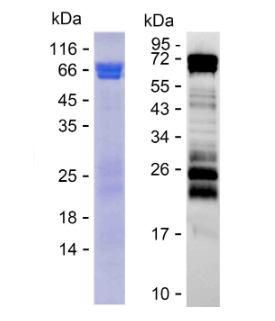
CD155 [also known as PVR (poliovirus receptor) and Necl-5 (nectin-like molecule-5)] is a 70 kDa type I transmembrane (TM) glycoprotein that is a member of the nectin-like (Necl) family of nectin-related molecules. Like nectins, Necl molecules are Ig superfamily members that contain three Ig-like extracellular domains, a TM segment, and a cytoplasmic tail. Unlike nectins, Necl molecules cannot interact with cytoplasmic afadin. While Nectins serve as cell adhesion molecules, the actual functions of most Necls are yet-to-be determined. CD155/PVR was originally isolated based on its ability to mediate polio virus attachment to host cells. The full-length (or CD155 alpha isoform) is synthesized as a 417 amino acid (aa) precursor that contains a 20 aa signal sequence, a 323 aa extracellular region, a 24 aa TM segment and a 50 aa cytoplasmic tail. The extracellular region contains one N-terminal V-type and two C2-type Ig-like domains. The V-type domain mediates polio virus binding. Three other isoforms exist, all of which retain the Ig-like domains. CD155δ is transmembrane with a shortened cytoplasmic tail of 25 aa. CD155 beta (352 aa) and CD155 gamma (344 aa) are 60‑65 kDa soluble forms that show removal of the TM segment and surrounding amino acids. The soluble forms will bind the polio virus (due to the presence of the V-type Ig domain) but afford no protection against polio infection because of low circulating levels. CD155 has been demonstrated to bind vitronectin, nectin-3, and DNAM-1. DNAM-1 binding promotes monocyte migration and NK cell killing. CD155 is expressed in all normal tissues and is highly expressed in tumor cells of epithelial and neuronal origin.
CD155 [also known as PVR (poliovirus receptor) and Necl-5 (nectin-like molecule-5)] is a 70 kDa type I transmembrane (TM) glycoprotein that is a member of the nectin-like (Necl) family of nectin-related molecules. Like nectins, Necl molecules are Ig superfamily members that contain three Ig-like extracellular domains, a TM segment, and a cytoplasmic tail. Unlike nectins, Necl molecules cannot interact with cytoplasmic afadin. While Nectins serve as cell adhesion molecules, the actual functions of most Necls are yet-to-be determined. CD155/PVR was originally isolated based on its ability to mediate polio virus attachment to host cells. The full-length (or CD155 alpha isoform) is synthesized as a 417 amino acid (aa) precursor that contains a 20 aa signal sequence, a 323 aa extracellular region, a 24 aa TM segment and a 50 aa cytoplasmic tail. The extracellular region contains one N-terminal V-type and two C2-type Ig-like domains. The V-type domain mediates polio virus binding. Three other isoforms exist, all of which retain the Ig-like domains. CD155δ is transmembrane with a shortened cytoplasmic tail of 25 aa. CD155 beta (352 aa) and CD155 gamma (344 aa) are 60‑65 kDa soluble forms that show removal of the TM segment and surrounding amino acids. The soluble forms will bind the polio virus (due to the presence of the V-type Ig domain) but afford no protection against polio infection because of low circulating levels. CD155 has been demonstrated to bind vitronectin, nectin-3, and DNAM-1. DNAM-1 binding promotes monocyte migration and NK cell killing. CD155 is expressed in all normal tissues and is highly expressed in tumor cells of epithelial and neuronal origin.
Overview
Standard Curve Range | 312.5pg/ml-20000pg/ml |
Standard Curve Gradient | 7 Points/3 Folds |
Number of Incubations | 2 |
Detectable Sample | Liquid phase sample of soluble substances. For example: serum, plasma, cell culture supernatant, tissue grinding liquid, etc. |
Sample Volume | 50 μl |
Type | Not Ready-to-Use |
Operation Duration | 120min |
Alternative Names | Nectin-like protein 5 |
Gene Symbol | PVR, PVS |
Entrez Gene | 5817 (Human) |
SwissProt | P15151 (Human) |
*AREX continuously optimizes our products. Webpage content may not reflect the latest updates. For inquiries, please contact info@arexbio.com or your local distributor.
Data
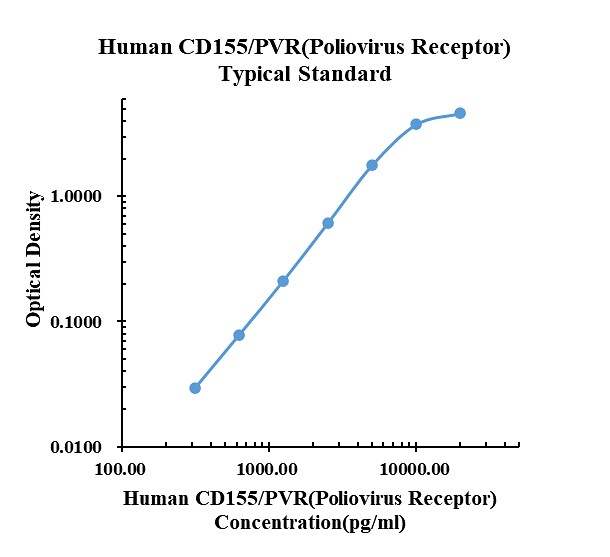
<table><tr><td>pg/ml</td><td>O.D.1</td><td>O.D.2</td><td>Average</td><td>Corrected</td></tr><tr><td>0.00</td><td>0.0277</td><td>0.0335</td><td>0.0306</td><td></td></tr><tr><td>312.50</td><td>0.0615</td><td>0.0580</td><td>0.0598</td><td>0.0292</td></tr><tr><td>625.00</td><td>0.1073</td><td>0.1096</td><td>0.1085</td><td>0.0779</td></tr><tr><td>1250.00</td><td>0.2368</td><td>0.2466</td><td>0.2417</td><td>0.2111</td></tr><tr><td>2500.00</td><td>0.6769</td><td>0.5968</td><td>0.6369</td><td>0.6063</td></tr><tr><td>5000.00</td><td>1.8730</td><td>1.7130</td><td>1.7930</td><td>1.7624</td></tr><tr><td>10000.00</td><td>3.8490</td><td>3.7014</td><td>3.7752</td><td>3.7446</td></tr><tr><td>20000.00</td><td>4.5993</td><td>4.6608</td><td>4.6301</td><td>4.5995</td></tr></table>
Product Features
• Optimized capture and detection antibody pairings with recommended concentrations save lengthy development time
• Development protocols are provided to guide further assay optimization
• Assay can be customized to your specific needs
• Economical alternative to complete kits
Kit Content
• Capture Antibody
• Detection Antibody
• Recombinant Standard
• Streptavidin conjugated to horseradish-peroxidase (Streptavidin-HRP)
Other Reagents Required
ARExSet® Ancillary Reagent Kit (5 plates): containing 96 well microplates, plate sealers, substrate solution, stop solution, plate coating buffer (PBS), wash buffer, and assay buffer. The components listed above may be purchased separately:
• 96 well microplates: AREX Biosciences, Catalog # DSEP01.
• Plate Sealers: AREX Biosciences, Catalog # DSSF01.
• Coating Buffer: 137 mM NaCl, 2.7 mM KCl, 8.1 mM Na2HPO4, 1.5 mM KH2PO4, pH 7.2-7.4, 0.2 μm filtered. AREX Biosciences, Catalog # DSCB01.
• Blocking Buffer: AREX Biosciences, Catalog # DSBB01.
• Wash Buffer: 0.05% Tween 20 in PBS, pH 7.2-7.4. AREX Biosciences, Catalog # DSWB01.
• Assay Buffer: 0.5%BSA,0.05%Tween20,PBS Solution.AREX Biosciences, Catalog # DSAB01
• Substrate Solution: Tetramethylbenzidine. AREX Biosciences, Catalog # DSTS01.
• Stop Solution: 0.5mol/L H2SO4. AREX Biosciences, Catalog # DSSS01.
Storage
Store components at 4°C or -20°C. Keep microplate wells sealed in a dry bag with desiccants. Do not expose test reagents to heat, sun or strong light during storage and usage. Please refer to the product user manual for detail temperatures of the components.
Note
For Research Use Only. Not for diagnostic, therapeutics, prophylactic or in vivo use.


 Instruction

 Product Details