Background
4-1BB is an inducible T cell surface protein belonging to the TNF receptor superfamily. It is alternatively known as TNFRSF9, CD137, and ILA. The 255 amino acid human 4-1BB is a type I transmembrane protein having in its extracellular domain four of the cysteine-rich motifs that are characteristic of the TNF receptor superfamily. The 30 kDa glycoprotein exists both as a monomer and as a dimer on T cells. The human and mouse proteins share 60% amino acid identity. 4-1BB is absent from naive T cells, but it is upregulated and continually expressed following T cell activation. The natural ligand, 4-1BBL, is a member of the TNF superfamily and is expressed on activated antigen presenting cells including dendritic cells, macrophages, and B cells. Cross-linking of 4-1BB by 4-1BBL or by agonistic antibodies transmits a potent co-stimulatory signal that enhances the effect of other activating signals such as PHA or anti-CD3 antibodies. 4-1BB signals through theTFAF2‑NIK pathway resulting in activation of NF-kappa B and ultimately promoting proliferation and survival of T cells.
Overview
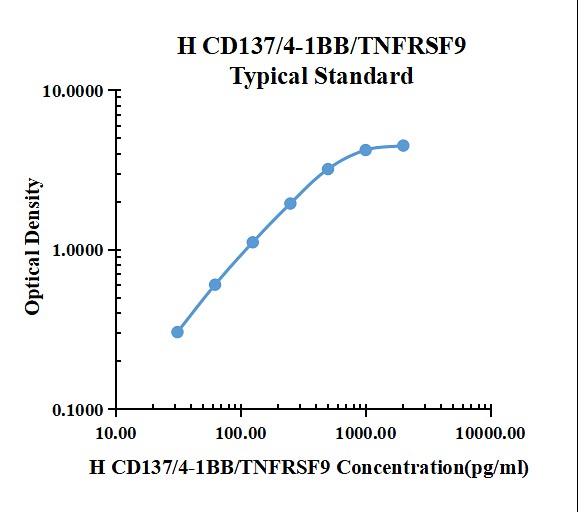
Standard Curve Range | 31.25 pg/ml -2000 pg/ml |
Standard Curve Gradient | 7 Points/3 Folds |
Number of Incubations | 2 |
Detectable Sample | Liquid phase sample of soluble substances. For example: serum, plasma, cell culture supernatant, tissue grinding liquid, etc. |
Sample Volume | 50 μl |
Type | Not Ready-to-Use |
Operation Duration | 120min |
Alternative Names | 4-1BB ligand receptor, CDw137, T-cell antigen 4-1BB homolog, T-cell antigen ILA |
Gene Symbol | TNFRSF9, CD137, ILA |
Entrez Gene | 3604 (Human) |
SwissProt | Q07011 (Human) |
*AREX continuously optimizes our products. Webpage content may not reflect the latest updates. For inquiries, please contact info@arexbio.com or your local distributor.
Data

<table><tr><td>pg/ml</td><td>O.D.1</td><td>O.D.2</td><td>Average</td><td>Corrected</td></tr><tr><td>0.00</td><td>0.0600</td><td>0.0586</td><td>0.0593</td><td></td></tr><tr><td>31.25</td><td>0.3588</td><td>0.3696</td><td>0.3642</td><td>0.3049</td></tr><tr><td>62.50</td><td>0.6741</td><td>0.6532</td><td>0.6637</td><td>0.6044</td></tr><tr><td>125.00</td><td>1.1700</td><td>1.1770</td><td>1.1735</td><td>1.1142</td></tr><tr><td>250.00</td><td>2.0070</td><td>2.0090</td><td>2.0080</td><td>1.9487</td></tr><tr><td>500.00</td><td>3.2720</td><td>3.2520</td><td>3.2620</td><td>3.2027</td></tr><tr><td>1000.00</td><td>4.3292</td><td>4.2228</td><td>4.2760</td><td>4.2167</td></tr><tr><td>2000.00</td><td>4.5309</td><td>4.5813</td><td>4.5561</td><td>4.4968</td></tr></table>
Product Features
• Optimized capture and detection antibody pairings with recommended concentrations save lengthy development time
• Development protocols are provided to guide further assay optimization
• Assay can be customized to your specific needs
• Economical alternative to complete kits
Kit Content
• Capture Antibody
• Detection Antibody
• Recombinant Standard
• Streptavidin conjugated to horseradish-peroxidase (Streptavidin-HRP)
Other Reagents Required
ARExSet® Ancillary Reagent Kit (5 plates): containing 96 well microplates, plate sealers, substrate solution, stop solution, plate coating buffer (PBS), wash buffer, and assay buffer. The components listed above may be purchased separately:
• 96 well microplates: AREX Biosciences, Catalog # DSEP01.
• Plate Sealers: AREX Biosciences, Catalog # DSSF01.
• Coating Buffer: 137 mM NaCl, 2.7 mM KCl, 8.1 mM Na2HPO4, 1.5 mM KH2PO4, pH 7.2-7.4, 0.2 μm filtered. AREX Biosciences, Catalog # DSCB01.
• Blocking Buffer: AREX Biosciences, Catalog # DSBB01.
• Wash Buffer: 0.05% Tween 20 in PBS, pH 7.2-7.4. AREX Biosciences, Catalog # DSWB01.
• Assay Buffer: 0.5%BSA,0.05%Tween20,PBS Solution.AREX Biosciences, Catalog # DSAB01
• Substrate Solution: Tetramethylbenzidine. AREX Biosciences, Catalog # DSTS01.
• Stop Solution: 0.5mol/L H2SO4. AREX Biosciences, Catalog # DSSS01.
Storage
Store components at 4°C or -20°C. Keep microplate wells sealed in a dry bag with desiccants. Do not expose test reagents to heat, sun or strong light during storage and usage. Please refer to the product user manual for detail temperatures of the components.
Note
For Research Use Only. Not for diagnostic, therapeutics, prophylactic or in vivo use.