Background
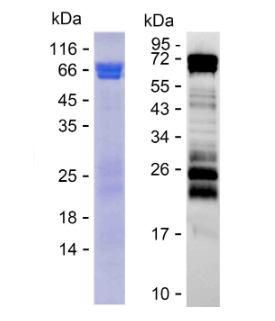
Myeloid progenitor inhibitory factor (MPIF-1), also known as CK beta 8 and MIP-3, is a member of the CC chemokine subfamily that is designated CCL23. Alternative splicing of the MPIF-1 gene results in two mRNAs that encode a short (CK beta 8) and a long (CK beta 8-1) isoform of the chemokine. CK beta 8 cDNA encodes a 120 amino acid (aa) residue precursor protein with a putative 21 aa residue signal peptide that is cleaved to generate a 99 aa residue mature CK beta 8 (aa 22 - 120). Additional N-terminal processing of the 99 aa residue variant can generate a 75 aa residue CK beta 8 (aa 46 - 120) that is significantly more active than the 99 aa residue variant. Similarly, CK beta 8-1 encodes a 137 aa residue precursor protein that can give rise to a 116 and a 92 aa residue chemokine. Among CC chemokine members, MPIF-1 is most closely related to MIP-5/CCL15 (67% sequence identity) and MIP-1 alpha /CCL3 (51%). MPIF-1 mRNA is most abundant in the adult lung and liver, but is also present in bone marrow, placenta, and various myelomonocytic cell lines. MPIF-1 has been shown to suppress the low proliferative potential colony-forming cells that give rise to granulocyte and monocyte lineages. MPIF-1 binds to CCR1 with high affinity and has been shown to be a potent chemoattractant and activator of monocytes, dendritic cells, and osteoclast precursors.
Myeloid progenitor inhibitory factor (MPIF-1), also known as CK beta 8 and MIP-3, is a member of the CC chemokine subfamily that is designated CCL23. Alternative splicing of the MPIF-1 gene results in two mRNAs that encode a short (CK beta 8) and a long (CK beta 8-1) isoform of the chemokine. CK beta 8 cDNA encodes a 120 amino acid (aa) residue precursor protein with a putative 21 aa residue signal peptide that is cleaved to generate a 99 aa residue mature CK beta 8 (aa 22 - 120). Additional N-terminal processing of the 99 aa residue variant can generate a 75 aa residue CK beta 8 (aa 46 - 120) that is significantly more active than the 99 aa residue variant. Similarly, CK beta 8-1 encodes a 137 aa residue precursor protein that can give rise to a 116 and a 92 aa residue chemokine. Among CC chemokine members, MPIF-1 is most closely related to MIP-5/CCL15 (67% sequence identity) and MIP-1 alpha /CCL3 (51%). MPIF-1 mRNA is most abundant in the adult lung and liver, but is also present in bone marrow, placenta, and various myelomonocytic cell lines. MPIF-1 has been shown to suppress the low proliferative potential colony-forming cells that give rise to granulocyte and monocyte lineages. MPIF-1 binds to CCR1 with high affinity and has been shown to be a potent chemoattractant and activator of monocytes, dendritic cells, and osteoclast precursors.
Overview
Standard Curve Range | 15.63 pg/ml -1000 pg/ml |
Standard Curve Gradient | 7 Points/3 Folds |
Number of Incubations | 2 |
Detectable Sample | Not specified |
Sample Volume | 50 μl |
Type | Not Ready-to-Use |
Operation Duration | 120min |
Alternative Names | CK-beta-8, Macrophage inflammatory protein 3, Myeloid progenitor inhibitory factor 1, Small-inducible cytokine A23 |
Gene Symbol | CCL23, MIP3, MPIF1, SCYA23 |
Entrez Gene | 6368 (Human) |
SwissProt | P55773 (Human) |
*AREX continuously optimizes our products. Webpage content may not reflect the latest updates. For inquiries, please contact info@arexbio.com or your local distributor.
Data
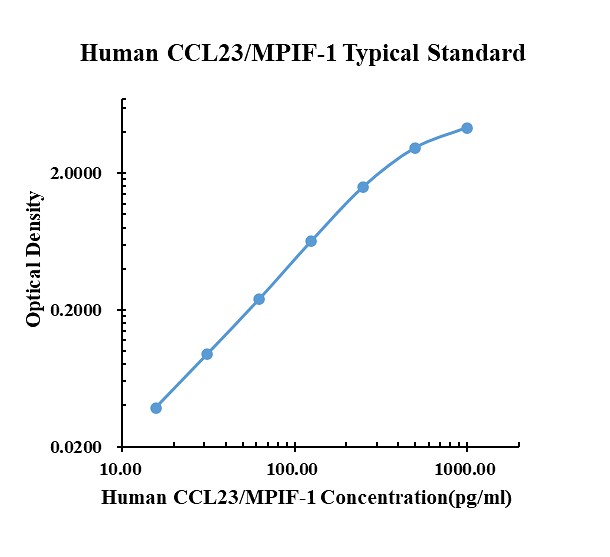
<table><tr><td>pg/ml</td><td>O.D.1</td><td>O.D.2</td><td>Average</td><td>Corrected</td></tr><tr><td>0.00</td><td>0.0107</td><td>0.0101</td><td>0.0104</td><td></td></tr><tr><td>15.63</td><td>0.0509</td><td>0.0471</td><td>0.0490</td><td>0.0386</td></tr><tr><td>31.25</td><td>0.1097</td><td>0.1023</td><td>0.1060</td><td>0.0956</td></tr><tr><td>62.50</td><td>0.2577</td><td>0.2433</td><td>0.2505</td><td>0.2401</td></tr><tr><td>125.00</td><td>0.6426</td><td>0.6466</td><td>0.6446</td><td>0.6342</td></tr><tr><td>250.00</td><td>1.5590</td><td>1.6230</td><td>1.5910</td><td>1.5806</td></tr><tr><td>500.00</td><td>2.9850</td><td>3.1380</td><td>3.0615</td><td>3.0511</td></tr><tr><td>1000.00</td><td>4.2340</td><td>4.3629</td><td>4.2985</td><td>4.2881</td></tr></table>
Product Features
• Optimized capture and detection antibody pairings with recommended concentrations save lengthy development time
• Development protocols are provided to guide further assay optimization
• Assay can be customized to your specific needs
• Economical alternative to complete kits
Kit Content
• Capture Antibody
• Detection Antibody
• Recombinant Standard
• Streptavidin conjugated to horseradish-peroxidase (Streptavidin-HRP)
Other Reagents Required
ARExSet® Ancillary Reagent Kit (5 plates): containing 96 well microplates, plate sealers, substrate solution, stop solution, plate coating buffer (PBS), wash buffer, and assay buffer. The components listed above may be purchased separately:
• 96 well microplates: AREX Biosciences, Catalog # DSEP01.
• Plate Sealers: AREX Biosciences, Catalog # DSSF01.
• Coating Buffer: 137 mM NaCl, 2.7 mM KCl, 8.1 mM Na2HPO4, 1.5 mM KH2PO4, pH 7.2-7.4, 0.2 μm filtered. AREX Biosciences, Catalog # DSCB01.
• Blocking Buffer: AREX Biosciences, Catalog # DSBB01.
• Wash Buffer: 0.05% Tween 20 in PBS, pH 7.2-7.4. AREX Biosciences, Catalog # DSWB01.
• Assay Buffer: 0.5%BSA,0.05%Tween20,PBS Solution.AREX Biosciences, Catalog # DSAB01
• Substrate Solution: Tetramethylbenzidine. AREX Biosciences, Catalog # DSTS01.
• Stop Solution: 0.5mol/L H2SO4. AREX Biosciences, Catalog # DSSS01.
Storage
Store components at 4°C or -20°C. Keep microplate wells sealed in a dry bag with desiccants. Do not expose test reagents to heat, sun or strong light during storage and usage. Please refer to the product user manual for detail temperatures of the components.
Note
For Research Use Only. Not for diagnostic, therapeutics, prophylactic or in vivo use.


 Instruction

 Product Details