AREX® Fluor 488 Wheat Germ Agglutinin (WGA)
 Datasheet
Key features and details
Fluor 488-conjugated wheat germ agglutinin (WGA)
- Target:
- Source/Host:
- Reactivity:
- Applications:
- Conjugation:
- Storage:
-
Brand:

CAT.NO. : ARA5801
US$ Please choose
US$ Please choose
 Product Details
Background
Wheat germ agglutinin (WGA) is a lectin that binds specifically to N-acetylglucosamine and N-acetylneuraminic acid (sialic acid) residues on glycoconjugates and oligosaccharides. These glycans are abundant on the cell surface, so fluorescent WGA conjugates are widely used to label the plasma membrane in fluorescence imaging and cell-painting assays, and to study glycosylation patterns and glycan-mediated processes in cells and tissues. AREX® Fluor 488 Wheat Germ Agglutinin (WGA) has excitation/emission maxima of 491/512 nm and is suitable for living cells, fixed cells and tissue sections.
Application
To ensure optimal assay performance, AREX recommends conducting reagent titration tailored to each testing system for optimal detection results.
*Results are sample-specific. Please refer to your local assay conditions and test parameters for reference.
Application | Dilution Ratio |
IF/ICC | Assay-dependent |
Overview
Description | Fluor 488-conjugated wheat germ agglutinin (WGA) for IF/ICC. |
Specificity | Binds N-acetylglucosamine and N-acetylneuraminic acid residues on glycoconjugates and oligosaccharides. |
Form/Buffer | Lyophilized powder. Ex/Em = 491/512 nm. |
Subcellular Location | Cell membrane |
Alternative Names | WGA, Wheat germ agglutinin |
*Clone Number, Reactivity, Source/Host and Clonality can be found in the product name and Key Features section above.
Data
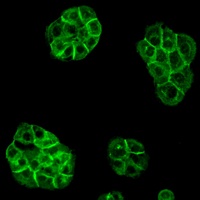
Cells were stained with AREX® Fluor 488 Wheat Germ Agglutinin (WGA) (ARA5801), which labels N-acetylglucosamine and sialic acid residues on the cell surface.
Storage
Store at 4°C short term. For long term storage, store at -20°C, avoiding freeze/thaw cycles.
Note
For Research Use Only. Not for diagnostic, therapeutics, prophylactic or in vivo use.
FAQs
What are the main types of research antibodies and how do they differ?

Research antibodies are mainly divided into monoclonal antibodies and polyclonal antibodies. Monoclonal antibodies typically offer higher specificity and better batch-to-batch consistency, while polyclonal antibodies often provide stronger affinity but may show more variation between batches. The choice depends on your specific experimental needs.
How can I tell if a research antibody is suitable for my experiment?
It is recommended to carefully review the product datasheet for validated applications, species reactivity, recommended dilutions, and published references. For new antibodies, performing a small-scale validation with positive control samples is usually helpful.
Can improper storage of research antibodies affect experimental results?
Yes. Antibodies are sensitive to temperature, repeated freeze-thaw cycles, and contamination. Improper storage may lead to reduced activity, increased background, or weaker signals. It is best to follow the storage instructions provided in the product datasheet.
Why doesn’t the recommended dilution in the datasheet work well in my experiment?
The recommended dilution is based on the supplier’s test conditions. Factors such as sample type, fixation method, and detection system in your lab can influence the optimal working concentration. Performing a dilution series optimization in your own system is often necessary.
What precautions should I take when using a newly purchased research antibody for the first time?
It is advisable to briefly centrifuge the antibody (especially concentrated or lyophilized ones), then perform a small-scale pilot experiment using the recommended conditions. Recording the batch number and usage date is also helpful for future tracking.
New Products