마우스 IL-2 ELISA 키트
 프로토콜 소책자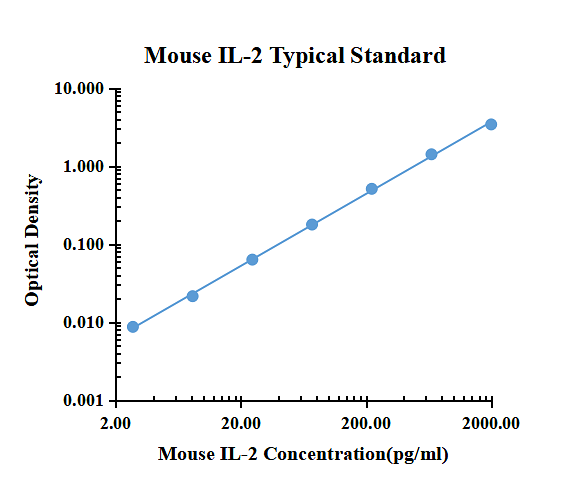
주요 기능 및 세부정보
- 사양:
- 감도:
- 표준 곡선 범위:
- 표준 곡선 기울기:
- 배양 횟수:
- 샘플량:
- 분석 유형:
- 작동 기간:
-
브랜드:

 제품 세부정보
배경
T 세포 성장 인자(TCGF)로도 알려진 인터루킨 2(IL-2)는 공통 감마 사슬(감마 c) 사이토카인 계열의 구성원인 15-18 kDa 가변 글리코실화 알파-나선형 폴리펩티드입니다. 단량체로 존재하며, 반감기가 현저히 짧습니다(< 30 minutes). Human IL-2 is synthesized as a 153 amino acid (aa) precursor that contains a 20 aa signal sequence plus a 133 aa mature region. The mature region is alpha -helical in nature, and contains one utilized O-linked glycosylation site at Thr3 plus three cysteines, two of which form an intrachain disulfide bond that is essential for activity. Mature human IL-2 shares 73%, 66%, 78% and 97% aa identity with canine, rat, feline and rhesus monkey IL-2, respectively. Although human IL-2 shares only approximately 60% aa identity with the highly polymorphic mouse IL-2, human IL-2 is known to be active on mouse IL-2 responsive cells. Cells reported to secrete IL-2 include gamma δ T cells, activated conventional CD4+ and CD8+ T cells, neurons, microglia, and hematopoietic stem cells.
The receptor for IL-2 (IL-2 R) is composed of three subunits, the 55 kDa CD25/IL-2 R alpha chain, the 70 kDa IL-2 R beta chain, and the 65 kDa Common gamma Chain. IL-2 first binds to CD25, the binary complex then recruits IL-2 R beta and gamma c to form the quaternary signaling complex. In addition to IL-2, IL-2 R beta is used by IL-15 in its quaternary signaling complex. gamma c also serves as a signaling receptor for IL-4, -7, -9, -15, and -21.
In vitro studies have shown an important role for IL-2 in T cell activation and expansion. In vivo, IL-2 is critical for the development, maintenance and function of regulatory T cells (Treg) which provide protection against autoimmune disease. On the other hand, IL-2 can also promote autoimmune inflammation in target organs through its roles in regulating the expression of T cell trafficking genes, and production of Th2 cytokines. Within the CD8+ T cell subset, IL-2 is essential for optimal primary responses and differentiation into terminal effector cells. IL-2 also promotes the development of activated CD8+ T cells into memory cells.
일반적인 데이터
| pg/ml | 외경 | 평균 | 수정됨 | |
| 0.00 | 0.0100 | 0.0090 | 0.0095 | |
| 2.74 | 0.0182 | 0.0182 | 0.0182 | 0.0087 |
| 8.23 | 0.0310 | 0.0310 | 0.0310 | 0.0215 |
| 24.69 | 0.0720 | 0.0736 | 0.0728 | 0.0633 |
| 74.07 | 0.1837 | 0.1918 | 0.1878 | 0.1783 |
| 222.22 | 0.5283 | 0.5149 | 0.5216 | 0.5121 |
| 666.67 | 1.4151 | 1.4413 | 1.4282 | 1.4187 |
| 2000.00 | 3.4657 | 3.4090 | 3.4374 | 3.4279 |
정밀도
| 분석 내 정밀도 | 분석 간 정밀도 | |||||
| 샘플 번호 | S1 | S2 | S3 | S1 | S2 | S3 |
| 22 | 22 | 22 | 6 | 6 | 6 | |
| 평균(pg/ml) | 43.5 | 121.4 | 362 | 18.9 | 152.5 | 341.9 |
| 표준편차 | 2.2 | 6.0 | 19.4 | 0.4 | 2.8 | 12.5 |
| 변동계수(%) | 5.1 | 5.0 | 5.4 | 2.1 | 1.8 | 3.6 |
분석 내 정밀도(분석 내 정밀도) 알려진 농도의 3개 샘플을 하나의 플레이트에서 20회 테스트하여 분석 내 정밀도를 평가했습니다.
분석 간 정밀도(분석 간 정밀도) 알려진 농도의 3개 샘플을 한 플레이트에서 6회 테스트하여 분석 내 정밀도를 평가했습니다.
스파이크 복구
스파이크 회복은 건강한 마우스 혈청 샘플에 3가지 수준의 마우스 IL-2를 스파이킹하여 평가했습니다. 본 실험에서는 스파이킹되지 않은 혈청을 블랭크로 사용하였다.
회복 범위는 81%~108%였으며 전체 평균 회복률은 94%였습니다.
회복 범위는 81%~108%였으며 전체 평균 회복률은 94%였습니다.
샘플 값
| 샘플 매트릭스 | 샘플 평가됨 | 범위(pg/ml) | 감지 가능(%) | 검출 평균(pg/ml) |
| 혈청 | 30 | n.d.-0.67 | 21 | 0.23 |
혈청/혈장 – 이 분석에서는 명백히 건강한 생쥐의 샘플 30개에서 IL-2의 존재 여부를 평가했습니다. 기증자에 대한 병력이 없습니다.
n.d. =-검출할 수 없습니다. 감도 이하로 측정된 샘플은 검출 불가능한 것으로 간주됩니다.
신제품